In Q2 2023, I signed off on a contract for indexable inserts for our multi-axis turning centers that priced about 40% higher per edge than what we'd been paying ($268 vs $192 per box of 10). Twelve months later, our per-part tooling cost came down 19%.
That's not a typo. The price on the insert box isn't the cost. Cost is price divided by useful part output, plus changeover downtime, scrap rate, and operator time.
We changed one variable — insert brand — and cut our per-part cost by nearly a fifth while the sticker went up 40%. Here's the arithmetic.
Where these numbers come from
I'm the procurement manager at an Ohio precision machine shop — 180 employees, roughly $54M annual revenue. I've managed our tooling budget (about $210,000 a year) for six years. Before that I was a production planner, so I understand the cutting parameters behind the numbers.
We track roughly 2,300 insert and holder SKUs across five machining cells and 14 multi-axis CNC lathes. Since our new ERP module went live in 2021, I've logged every purchase. The first two years, it was just an exercise in cost control. Now it's the reason I don't place an order without checking per-part data first.
What the cheaper insert actually cost us
The alternative insert we'd been using — let me be fair, it wasn't garbage. It cut metal. The problem was unpredictability. Same batch, one edge would run 160 parts fine, another would chip at 90. Average life was 120 parts per edge, but that average hid the swings.
In multi-axis turning — especially on parts that go through several operations — that swing means either changing an edge early or pushing a dying edge and crossing your fingers. Both are bad outcomes. One wastes money, the other creates scrap.
Sandvik Coromant's inserts didn't do that. Our tool-life records showed 200 to 210 parts per edge on the same cast iron turning work, with almost no variance. That meant operators could plan changeovers instead of guessing.
Run the per-part math with our pricing: the cheaper insert at $19.20 per edge, 120 parts, comes to $0.160 per part. Sandvik Coromant at $26.80 per edge, 207 parts, comes to $0.130 per part. That's a 19% gap. Forty percent more on the sticker, 19% less per part.
That's before the downtime. A single unplanned index — pull the insert, swap, touch off, restart the program — runs about 45 minutes. At our shop rate, that's $800 to $1,200 depending on which machine goes down. With the cheaper insert, we were averaging two unplanned indexes per week (numbers pulled from our 2023 machine downtime log, not an estimate).
I'm not a metallurgist, so I can't explain why Sandvik Coromant's Inveio coating performs better at the microstructure level. What I can tell you is that in our cast iron turning, tool life ran about 30% longer at identical cutting parameters. That's a measured number from our tool-life log, not a guess.
The decision I kept second-guessing
I went back and forth between the two options for close to three weeks. The cheaper one was what we'd been running; I was used to it. Sandvik Coromant was pricier — I knew there was brand premium baked in. I built a TCO model in Excel, cheap at $0.160 per part versus Sandvik at $0.130. Then I showed it to our shop supervisor. What he said stuck with me: "Make the switch. We're already spending more time on the cheap inserts than we're saving on the price difference."
Even after I cut the PO, I kept asking myself if I was paying a brand tax. I checked every spec against the Sandvik Coromant official website before signing, but I still wasn't fully sure. It took until month three for the per-part cost on comparable jobs to visibly drop. By month six, I had enough data to say it was the right call. I won't pretend I felt confident in week one.
When the cheaper option still makes sense
Let me be clear: I'm not saying everyone should always buy the most expensive insert. The cheap inserts worked fine for us for two years. The problem only surfaced when we started running more complex parts with tighter tolerances.
If your situation is high-mix, low-volume, with tolerances you can hit at ±0.005 inches comfortably, the cheaper insert might be all you need. A former colleague of mine runs a small job shop doing basic turning — he's used budget inserts for years without a problem. His data isn't our data, and I'm not going to pretend our experience is universal.
Also, these numbers are specific to steel and cast iron. If your shop runs mostly stainless, superalloys, or titanium, the wear mechanics are different and my experience isn't enough to guide you. Talk to your tooling engineer, not me.
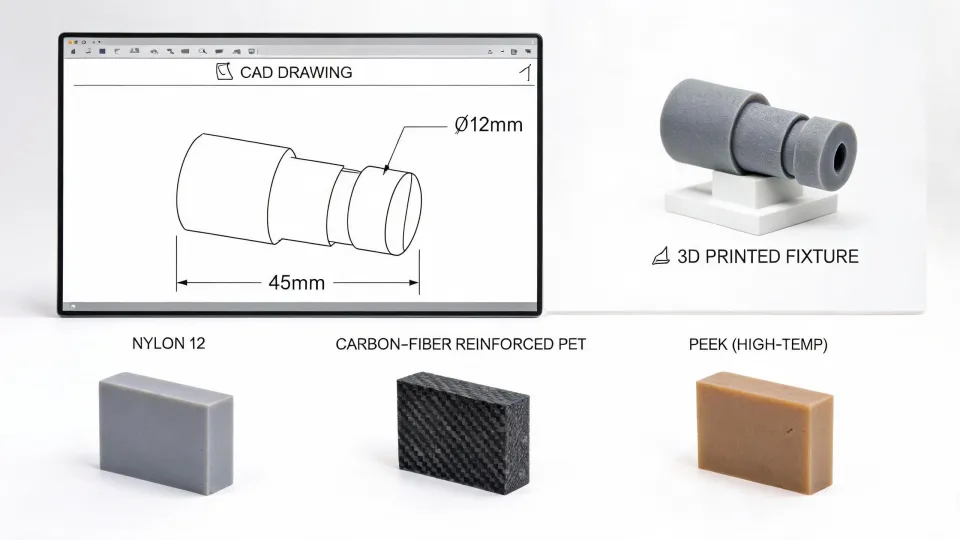
One last thing: we did evaluate 3D printing for custom tooling on our multi-axis turning setup. For our volumes — about 1,800 parts a month on one cell — additive manufacturing came in at 4 to 5 times the cost per part versus CNC. 3D printing has its place for prototypes and low-volume runs, but at our production level, multi-axis turning still wins on economics.
So I don't start with the price per insert anymore. I start with the cost per part and work backward. The numbers usually make the decision for me.