Material visibility
Quotes identify polymer family, expected support waste, and whether recycled or bio-based options are technically appropriate.
Additive manufacturing can reduce waste when the application is chosen carefully. Ultimaker documents material, energy, and logistics assumptions instead of making vague green claims.
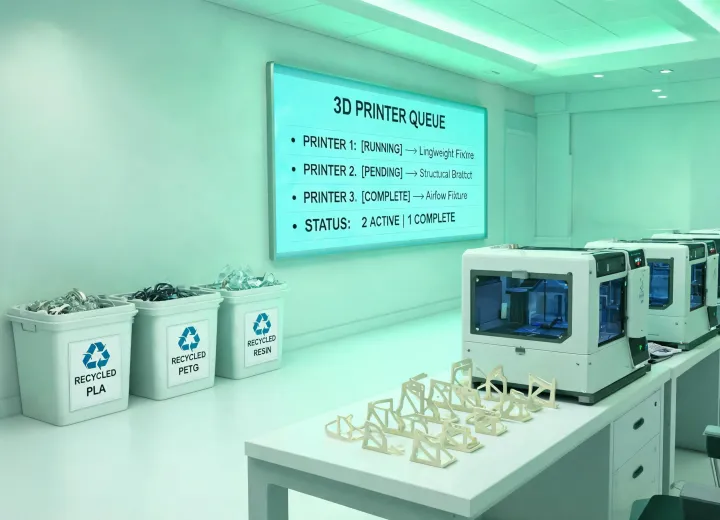
Quotes identify polymer family, expected support waste, and whether recycled or bio-based options are technically appropriate.
Customer programs receive nesting and scheduling suggestions to reduce failed builds and idle machine hours.
Repeat tooling programs add refurbish, reprint, or redesign decision points tied to wear observations.
We compare additive production against machining, molding, and purchased components. A printed part is not automatically more sustainable; it becomes attractive when geometry, demand, and lifecycle fit the process. For example, a lightweight inspection nest may reduce transport damage and operator rework, while a cosmetic prototype ordered in the wrong material may create unnecessary failed builds.
Any waste, delivery, or efficiency statement is linked to the job context. For larger programs, we can record build orientation, failed-build learning, packaging choices, and shipping destinations on file. The result is a sustainability discussion that quality and purchasing can audit, rather than a decorative claim on a quote.
Ultimaker also separates equipment recommendations from printed-part recommendations. If a customer is better served by a shared printer cell, we state the operator and maintenance assumptions. If outsourced printing is cleaner for the demand profile, we document that boundary so capital spending is not justified by unrealistic utilization.
Share CAD, usage context, estimated annual demand, and inspection expectations. We will respond with a practical additive manufacturing path and documented assumptions.