There's no single right answer to 'which process should I use?' I've been handling prototyping and low-volume production orders for about eight years, and I've personally made enough expensive mistakes to buy a small used car. Somewhere north of $11,000 in wasted budget, honestly. Most of that came from choosing a process I was excited about, not one the part actually needed.
So let's cut through the noise. You're probably in one of these three scenarios:
- Scenario A: complex polymer geometry, design still changing, need parts in days → Ultimaker 3D printer.
- Scenario B: metal material, tight tolerances, or production volumes → CNC machining, like the Axis small vertical machining center VMC 650.
- Scenario C: flat parts cut from sheet or plate → laser cutting vs waterjet cutting.
Scenario A: Complex polymer part, fast iteration, design still moving
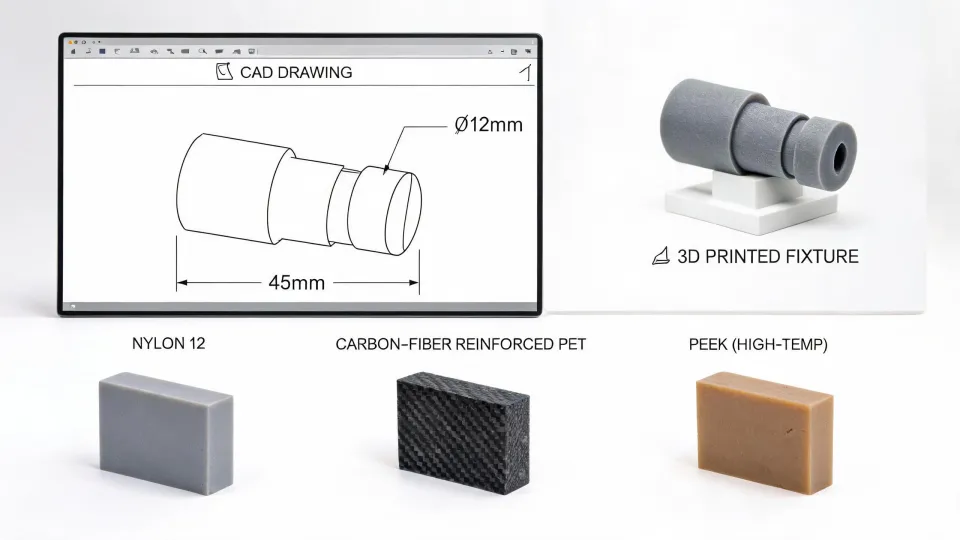
Let's start with the Ultimaker S5 3D printer specifications, because this is the machine I reach for in Scenario A. Build volume: 330 x 240 x 300 mm. Layer resolution: down to 0.06 mm with the fine print core, depending on which core you use (source: Ultimaker's spec sheet, accessed January 2025). That's enough for functional prototypes, jigs, and even short-run production components when you know the load directions.
I slice everything in Cura, and when I'm running more than one machine, Digital Factory lets me spot a failed print before I've wasted a whole shift. It's not flashy, but it saves me a ton of time. If you're small, you don't need a full machine shop to start; the Ultimaker is an honest starting point.
Now the mistake I hate admitting. In my first year, I made the classic material-strength error: I thought '100% infill' meant 'unbreakable.' I printed a mounting bracket for a customer's test rig in solid PLA and told them it was ready. It sheared along the layer lines on day two. Six parts, $620 in wasted material and shipping, and a credibility hit I didn't recover from. That's when I learned: FDM parts are directional. 'Solid' isn't the same as 'strong.'
Here's the counterintuitive part: 3D printing isn't always the cheapest option. I've had simple one-off aluminum CNC brackets quote at $85, while the 'free' 3D print consumed two days of engineering time and $40 in plastic to make a part that still needed finishing. For a simple bracket, machining from bar stock can beat additive on total cost. For a part with internal channels and undercuts? There's no way you'd machine that for $85. That's where the Ultimaker earns its rent.
And if you're a small operation, don't be embarrassed to ask for a single part. When I started freelancing, a local service bureau treated my $250 Ultimaker order like it was a $25,000 production run. That supplier has had my work ever since. Small doesn't mean unimportant; it means potential.
Scenario B: Metal, tight tolerances, or production volumes → CNC machining
If the drawing says stainless steel and the tolerance block is tighter than ±0.2 mm, 3D printing is not your first conversation. CNC machining of stainless steel is a different beast from aluminum: you need the right spindle speed, feed rate, tool coating, and coolant strategy. A small vertical machining center like the Axis VMC 650 is common in job shops because it gives you enough rigidity and accuracy for this kind of work without taking over the whole floor.
I once ordered 40 machined brackets in 304 stainless. I checked the material, I checked the critical hole sizes, but I skipped the surface finish callout because I thought 'we've done brackets like these before... it's basically the same.' The parts came back at 1.6 µm roughness when the drawing asked for 3.2 µm. The customer rejected the lot. $450 in scrap, three-day delay, and a very awkward phone call. I still kick myself. If I'd checked the drawing against the ISO 2768-m default tolerances, I would've caught it before the machine even started.
People assume CNC is only for big batches. Maybe that's true for complex parts, but not for simple prismatic profiles. One-off CNC can be surprisingly cheap if the shop stocks the material and the programming is simple. For 10 to 100 pieces, CNC usually wins on repeatability as long as the design is locked. The trick is to ask suppliers for options rather than telling them the process. Send the drawing and quantity, then say: 'Would you quote this as machined, or is additive worth discussing?' That one sentence has saved me thousands.
On the small-order subject: don't let anyone make you feel guilty for requesting two parts. A good shop will tell you their minimum honestly. The shop that laughs at your quantity? Cross them off. I've been on both sides of that table, and it never ends well for the supplier who treats small orders like a bother.
Scenario C: Flat sheet parts, speed, edge quality → laser cutting vs waterjet cutting
When the part starts as sheet metal or plate, the decision changes completely. That's where the laser cutting vs waterjet cutting question comes in.
Laser cutting will get you narrow kerf and high speed on thin and medium sheets. For 3 mm mild steel, a laser will usually beat waterjet on both price and turnaround — at least from every quote I've pulled in the last year. But the laser's edge gets rougher as thickness goes up, and the heat-affected zone can be a problem if the edge will be welded or exposed.
Waterjet cutting is the right tool when the material is thick, heat-sensitive, or oddly layered. Need 20 mm stainless plate that will face fatigue? Waterjet gives you a cold cut with no heat-affected zone. You'll pay for water and abrasive, but you won't pay for rework caused by discolored, hardened edges.
The mistake I made here: I had a 25 mm steel plate needing eight precision holes. Laser quote came in $50 cheaper than waterjet, and I grabbed it without thinking about taper or edge condition. Two holes came out slightly tapered, and the edge oxidization wasn't acceptable. Rework cost $220 and cost me a week. If I'd asked the supplier 'what's the best process for this thickness?' I'd have spent the extra $50 and saved $170 plus the headache.
So when you're comparing laser vs waterjet, don't just compare quote numbers. Compare the full path to a usable part.
How to decide: five questions that actually work
I'm not going to end with 'choose what fits your situation' — that's a cop-out. Here are the exact questions I work through on every order, the same ones on the checklist I keep above my desk:
- Is the design still changing? If yes, use an Ultimaker. Iterating on plastic is cheaper than iterating on metal.
- Is the material specified as metal or does the part carry real load? CNC machining (or another metal process) is almost certainly required.
- Is the part flat or made from sheet? Laser cutting vs waterjet cutting is your main debate, not additive.
- What's the quantity? One to ten complex parts: additive often wins. Ten to a hundred simple metal parts: CNC wins. Flat parts in quantity: cutting wins.
- What tolerance block is on the drawing? If it's tighter than ±0.1 mm, that's a machining conversation, not a layer-by-layer conversation.
In the past 18 months, that checklist has caught 47 potential errors before they became scrap. Three of those would have resulted in completely rejected lots. The cost of writing the checklist? Zero. The cost of learning those lessons the hard way? Way too much.
So here's my bottom line. There is no universal best process. An Ultimaker 3D printer is excellent for complex, polymer-heavy, iteration-heavy work. The Axis VMC 650 and a good tooling setup is excellent for precision metal parts. Laser and waterjet cutting are both excellent in their own lanes. The expensive mistakes come from falling in love with a process before you know what the part demands. Ask the right questions, and you'll spend less time crossing your fingers and more time shipping parts.
