Side note up front: if you landed here because you saw "vmc stock news" in a search result, this is not that article. Search intent can be a weird thing. But if you're trying to decide whether an Ultimaker S5 is worth it, or whether you should just use a 3D printing service in Istanbul for your next batch, you're in the right place. The two topics actually share a theme: decisions made under pressure, with incomplete information, tend to get expensive.
If you've ever watched a 14-hour print fail at hour 13, you know that particular hollow feeling. The layers look perfect until they don't. Then it's scrape, clean, check the nozzle, reload filament, and start over. Sound familiar? I thought my S5 was defective and almost sent it back. After four years and roughly 400 prints, I can say this without any drama: the printer wasn't the problem. I was. Or, more precisely, my workflow was.
The Surface Problem: "The Ultimaker S5 Is Unreliable"
I hear that sentence a lot. I said it myself in 2019. I had just moved from a desktop printer and expected a more expensive machine to be more automatic. It isn't. If you're searching for a "3D printer Ultimaker" because you want a dependable brand, the S5 is a fair starting point—but only if you're ready to spend as much on your workflow as you do on the hardware.
Most Ultimaker S5 3D printer reviews will tell you about the 330 x 240 x 300 mm build volume, the reliable motion system, and the excellent Cura integration. According to Ultimaker's official specifications (ultimaker.com, accessed January 2025), that build volume is accurate and the S5 is still a professional workhorse. But what reviews rarely emphasize is that all that capability sits downstream of your decisions.
Here's what you need to know: most failures on this machine are not random. They're caused by upstream decisions. Material choice, slicer profile, bed prep, model orientation, and a dozen small "this is fine" calls.
The Deep Problem: It Was Never the Machine
I started documenting every failed print in early 2020. I wanted to prove that the S5 was the problem and justify buying something else. The surprise wasn't the printer. The surprise was the failure pattern. The machine had very little to do with it.
Our failures fell into four buckets:
- Material assumptions – choosing PLA because it's easy, then wondering why a functional part warps or creeps.
- Slicing "just this once" – changing layer height, speed, or supports outside the validated profile. "It'll be fine" is a $400 phrase.
- Build plate prep – forgetting to re-check adhesion after a filament swap. The printer doesn't know you changed brands.
- Design for FDM – assuming a part designed for injection molding will print the same way.
Let me dig into the material bucket, because it's the most common and the most misunderstood.
PLA vs Resin 3D Printer: They're Not Interchangeable
I get asked about PLA vs resin 3D printer choices all the time. I get why. They're both "3D printing," but they're basically opposite workflows. It's basically a trade-off between surface finish and mechanical strength.
To be fair, resin wins on surface detail and small features. For miniatures, it's not close. But for a bracket, a duct, a jig, or any part under load, resin can be too brittle for long-term use, and standard PLA is not much better.
I once printed a production tool in standard PLA because "it's just a prototype." It broke on the second use. That cost us a deadline and a reputation hit. The "cheaper" material was actually the expensive choice. If I remember correctly, that episode ran us about $1,200 in rework and lost time. I might be misremembering the exact number, but I'm not misremembering the lesson.
My experience here is based on about 400 print jobs, mostly engineering prototypes and short-run functional parts. At least, that's been my experience with functional parts. I know a lot of people print gorgeous models on resin printers, and I'm not knocking that. But if you're printing miniatures or dental models, your experience will be completely different. I can't speak to that. None of this means 3D printing replaces CNC or injection molding. It's a complement, not a replacement.
When I Was Forced to Use a 3D Printing Service in Istanbul
Until 2022, I was stubborn about doing everything in-house. Then our S5 went down with a hotend jam caused by a third-party material with a filament diameter slightly out of spec. I knew I should check the diameter before loading, but thought, "what are the odds?" Well, the odds caught up with me. The filament swelled, jammed, and killed a weekend production run.
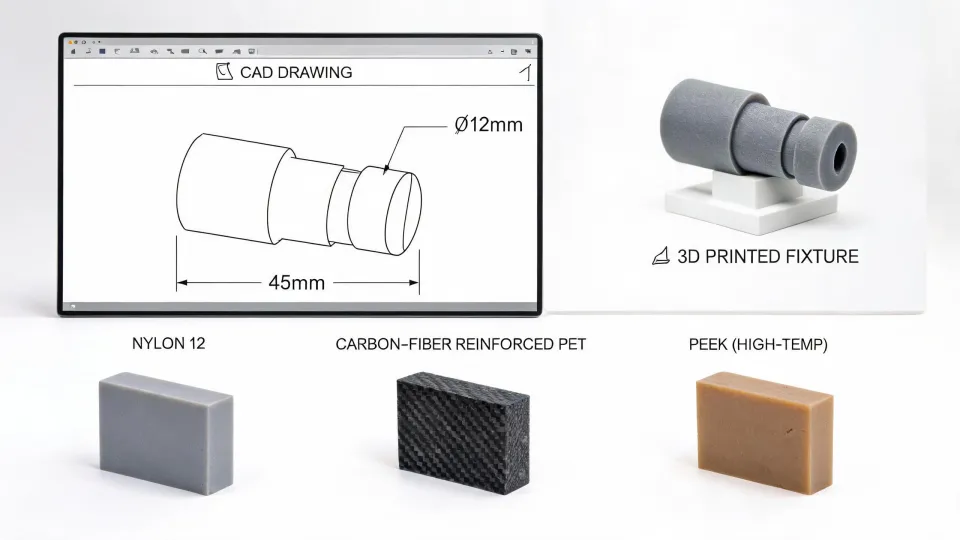
I called a 3D printing service in Istanbul as a last resort. Their engineers were running the same S5, but with a validated Cura profile and a different material that was better suited for the part. The parts arrived within 48 hours. Honestly, they were better than what I would have produced that week. The surprise wasn't their quality; it was how much I had been confusing "in-house control" with "efficiency." Sometimes the efficient move is to let someone else run the machine.
What This Pattern Actually Costs
Let's talk about money, because nobody wants to, and we all learn the hard way.
A failed print is never just a failed print. It's the wasted filament, the technician's time, the machine's downtime, the rescheduling, the engineering rework, and the email to the client saying "we're going to be a little late." That last part is the one that matters most, because trust is hard to rebuild.
- Failed prints – wasted material plus time. If you run a batch of 12 parts and all 12 warp, that's maybe $150 in filament and $800 in labor.
- Re-design – an hour in CAD is an hour you're not quoting new work.
- Rush outsourcing – emergency rates and overnight shipping are a markup on your own mistake.
- Client confidence – once you miss one deadline, the next conversation starts with "so, what if..."
One example from September 2022: I submitted a batch of parts where I had manually removed supports in the slicer because I "knew better." It looked fine on my screen. The result came back with ten of twelve parts warped. $890 in redo plus a 1-week delay. That's when I created our pre-flight checklist.
Since then, we've caught something like 47 potential errors with that checklist in the past 18 months. But don't quote me on the count. The point is the pattern is predictable once you look for it.
The Fix: A Few Simple Rules That Make the S5 a Boringly Good Printer
If you've come this far, you want solutions. Good. Here they are—short and unglamorous:
- Use one validated Cura profile per material. Don't let anyone "just tweak" it during a rush. If a change is needed, make it a deliberate test, not a silent edit to a production job.
- Treat material selection as part of design. Ask: is PLA okay here, or do I need PETG, Tough PLA, or a filled material? If surface finish is the only requirement, maybe resin is the better tool—but not necessarily on this machine.
- Check the printer before every run, not after a failure. Nozzle condition, bed adhesion, filament dryness. It takes four minutes. It saves money.
- Build a relationship with a service bureau. Even if you only use them once a year. A 3D printing service in Istanbul, or wherever your suppliers are, is a faster fix than replacing a $7,000 machine. That's not a shameful backup; it's capacity planning.
- Follow the "one variable" rule. If you change the material, don't change the profile, the model, and the environment in the same run. Otherwise you'll never know what caused the problem.
As of January 2025, the Ultimaker S5 is not Ultimaker's newest flagship—the Factor 4 took that spot. Prices and product lineups change fast, so verify current specs at ultimaker.com before you budget. But the core lesson hasn't changed: the machine is a tool, and your workflow is the system. Fix the workflow, and the S5 is kind of boring in the best way. It just prints.
To be fair to the "it's the printer's fault" crowd: yes, some machines ship with issues, and no printer is flawless. But after several years and thousands of dollars in avoidable mistakes, the most expensive problems I've had were the ones I created in the slicer or at the material drawer. The printer was just obeying.
Trust me on this one. I've got the failed prints to prove it.
