-
Who should use this checklist
-
What to look for when buying a 3d printer: the checklist
-
1. Define the part before the printer
-
2. Check material profiles before you check speed
-
3. Filter reviews by what the reviewer actually tested
-
4. Draw the repair timeline
-
5. Evaluate the 'factory' workflow
-
6. Order the boring stuff before the truck arrives
-
7. Write the training checklist before you unbox the machine
-
1. Define the part before the printer
-
Common mistakes I still see
-
Bottom line
Who should use this checklist
Six years ago, I almost bought a 3D printer the wrong way. I compared build volumes, read reviews, watched speed tests, and ignored the parts that actually make a machine reliable. Then I spent the next few years making up for it. I've been handling additive manufacturing orders for six years. I've personally made—and documented—eleven significant mistakes, totaling roughly $8,000 in wasted budget. This is the checklist I built so the rest of my team doesn't repeat those mistakes.
If you're searching for 'ultimaker s8 3d printer' and landed here, you're probably in the purchasing phase. Let's talk about what to look for when buying a 3d printer before you open the wallet. This is written from a production shop perspective, not a hobbyist one.
What to look for when buying a 3d printer: the checklist
Seven steps. No extra hype.
1. Define the part before the printer
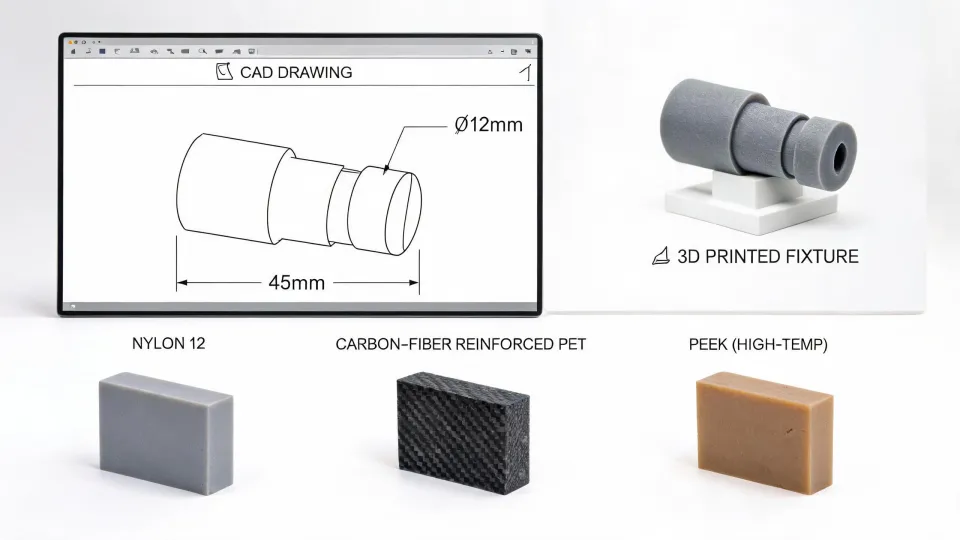
Not the spec sheet, not the reviews. Write down the three parts this machine must make in month one. For each, note the material, the mechanical load, and the environment. I once bought a machine with great XY resolution but it couldn't print the polycarbonate blend we needed for a jig. The spec sheet didn't say that. Checkpoint: if a machine can't do your material, nothing else matters.
2. Check material profiles before you check speed
People think expensive 3D printers deliver better parts because of precision. Actually, they deliver better parts because they maintain temperature, flow, and repeatability. A big part of that is material profiles. Ultimaker Cura has pre-built profiles for many materials. That means the printer starts from a known-good recipe instead of your guesswork. If you have to configure everything from scratch, budget time for it. If a vendor limits you to one filament brand, that's a decision you should make with eyes open.
3. Filter reviews by what the reviewer actually tested
If you've been reading 3d printer resin reviews because you want a production FDM machine, stop. Resin reviews usually show tiny statues and detailed jewelry. Those parts have different requirements than a load-bearing bracket. To be fair, resin printers are excellent for dental models, casting patterns, and visual prototypes. They're not a substitute for a large-format functional FDM part. And before you trust any 'best printer' list—resin or FDM—check the disclosure. Per FTC guidelines (ftc.gov), anyone who makes money from a review must say so. No disclosure? Red flag.
4. Draw the repair timeline
The machine will break. The question is how long until it's back. Find out where spare parts are sold, whether the vendor stocks them locally, and whether you can repair it yourself. I learned this after a hotend failure caused a $3,200 order to go sideways. The replacement took three weeks—or rather, closer to four with a lost package. Now I ask for the spare parts lead time before I sign a PO. If the vendor can't answer, that's a sign.
5. Evaluate the 'factory' workflow
If you're looking at an Ultimaker factory setup, consider the software platform as much as the hardware. Ultimaker's Digital Factory is the layer that links printers, materials, and job history. I can push a job to a printer from my desk and check whether it's still on track without walking across the shop. That might sound like a nice to have until you're managing five machines. Then it's a game-changer.
6. Order the boring stuff before the truck arrives
Spare print cores, build plates, cleaning filament, and—if you're adding an Air Manager or any fume extraction—a proper air hose cutting tool. That last one sounds weird, but the hose needs a clean cut so the fittings seal. Scissors crush it. A $20 air hose cutting tool saves a $40 hose and a week of awkward ventilation. Put it on the same PO as the printer.
7. Write the training checklist before you unbox the machine
I know this sounds like overkill. But by the time the printer is on the bench, you'll be distracted. Sit down for ten minutes and write the three most likely failure modes, plus who to call for support. Since I started doing this, we've caught 47 potential errors in 18 months. Maybe 47—I'd have to check the log. It's probably somewhere in the 40s. The point is, the checklist works.
Common mistakes I still see
Don't fall for the biggest build volume. A bigger bed means more room for failure if the heating isn't uniform. Buy the size that matches your actual parts, not your fantasies.
Don't ignore total cost of ownership. The printer is maybe half the expense. Filament, print cores, build sheets, service kits, and failed prototypes all add up. I'd rather buy a machine with a clear service plan than a cheaper machine with mystery consumables.
And if you came here specifically for the Ultimaker S8: as of January 2025, I couldn't find an official 'Ultimaker S8' on Ultimaker's current site. The current S-series model is the S7. Maybe an S8 will come later, but don't let a random listing sell you a machine that might be an older generation or a regional variant. Verify the model number at ultimaker.com.
This was accurate as of January 2025. The Ultimaker lineup and market prices change, so verify current models and spare parts availability at ultimaker.com before you budget.
Bottom line
When someone asks me what to look for when buying a 3d printer, I tell them to look for a system, not a spec sheet. Can you get spare parts? Can you repeat the same print? Can the team learn it without fighting the software? That's it. I'd rather spend ten minutes explaining those questions than deal with a mismatched purchase later. An informed buyer asks better questions and makes faster decisions. That's the kind of customer I want to work with.
