Every procurement conversation I've had about in-house fabrication tools eventually lands on the same question: what should we buy first? The honest answer is boring. It depends on what you're making, how many of them you need, and whether you need it Tuesday.
I've tracked about $180,000 in fabrication-related spend since 2019 for a 43-person product development shop. I'm not a machine fanboy. I get excited about utilization. The fundamentals haven't changed: measure total cost, verify actual demand, and buy for the work you do, not the work you want to do. What has changed is how accessible the tools are. Five years ago, a $6,000 professional FDM printer was a major line item. Now it's a normal capital expense. That doesn't mean it's a yes.
Prices move fast, so this is what I saw in late January 2025: the Ultimaker S5 3D printer price was around $5,995 base, plus shipping; the Pro Bundle with Air Manager and Material Station was closer to $7,000. A desktop fiber/diode unit like the xTool F1 wasn't a huge budget decision by comparison. Resin printers start even lower. CNC machining custom quotes vary by shop. Verify current numbers before you put anything in the budget.
Scenario A: Functional Plastic Parts in Low Volumes
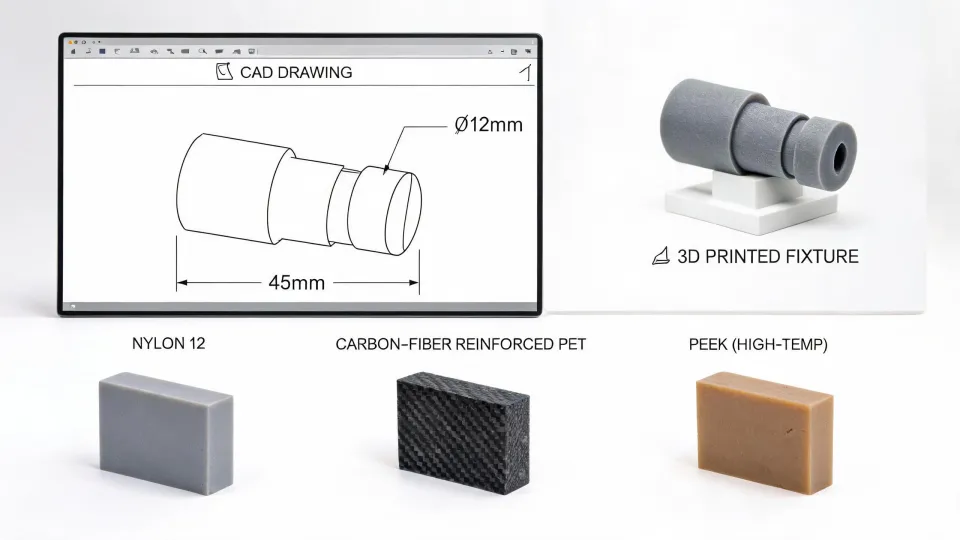
If most of your requests are jigs, fixtures, mounting brackets, housings, or custom end-use parts under roughly 330 x 240 x 300 mm, an FDM printer should be on your list. The Ultimaker S5 is the model I keep returning to because of the dual extrusion and material profiles. I can print PVA supports that dissolve instead of me spending an afternoon prying supports out of a small cavity.
The Ultimaker S5 3D printer price in January 2025 was about $5,995 base. That sounds like a lot until you compare it to outsourcing. In one of our 2024 customer jobs, I estimated 43 printed parts would have cost $9,800 through two online services. We printed them all on the S5 for about $3,200 in materials plus build time. The payback came to about eight months. That's the kind of math that makes procurement people smile.
The free Ultimaker Cura 3D printer software is just as important as the machine for cost control. It gives me a rough print time and material usage estimate before I quote. Cura also has material profiles for the parts we actually use, which reduces failed prints. A failed print is not just a quality issue. It is real cost: wasted material, wasted machine hours, wasted labor. Cura's estimate isn't perfect, but it's close enough for an initial quote.
Once we send jobs through Digital Factory, the queue tracks actual machine hours per part. That actual-hour data is what lets me split overhead and demonstrate utilization to the owner.
Is a resin 3D printer better than filament?
The question I hear most is: is a resin 3D printer better than filament? My short answer: sometimes. For high-detail miniatures, dental models, master patterns, and smooth cosmetic parts, resin wins. For functional parts that have to take load, survive shop floors, or hold dimensions in moderate heat, filament is usually the better material. Resin is brittle by comparison. UV exposure can make it weaker over time. I once had a resin prototype bracket snap from the weight of the cable it was holding—the part was beautiful, strong enough for a display, not strong enough for gravity. It was a bad material choice for that application.
Granted, industrial resins can be much stronger. But they also require separate post-processing and safety handling. For general shop tooling, filament is the less risky cost option.
Scenario B: Custom Metal Parts with Tolerances
The moment your drawing calls out threads, reamed holes, pressed-in inserts, or a material like 6061-T6 aluminum, 3D printing stops being the answer. That is when CNC machining custom parts becomes the shortest path to the real requirement.
Here's what I see on quotes: custom CNC machining has setup cost, material cost, and per-unit machine time. A typical small aluminum bracket from our local vendor was $150 setup, $22 per unit at 10 units, and $14 per unit at 100. The first article was also extra. A 3D printed prototype would cost maybe $6 in material and two hours of labor. That's why I use the S5 for fit checks before the metal order. We print the body, check mounting holes against the customer's fixture, then send the final geometry for CNC. That process saved us from machining two bad first articles in 2024.
Counterintuitive part: CNC can be cheaper than printing when post-processing is expensive. We quoted a part that printed for $6 in material, but the customer wanted a smooth visible finish. Sanding, priming, painting, and masking came to about $32 per part. The anodized aluminum machined version was $19 per part at 50 pieces. The 3D printed part was not cheaper. Nobody cares if it's printed. They care that it meets the spec at the lowest total cost.
Scenario C: Engraving and Marking on Metal
Laser marking is the most romanticized equipment purchase in our industry. A small machine can mark metal tools, label panels, and engrave a logo on everything in your office. It feels productive. Then it sits there for three weeks.
I almost bought one in 2023. The numbers said: nine marking jobs in the previous 12 months, total outside invoice cost $410. A machine's software, supplies, and lost bench space would have taken almost three years to pay back. In procurement terms, I was about to spend capital to solve a problem I didn't have.
For anyone looking at a desktop marking laser, the xTool F1 specifications for the fiber laser side matter: roughly 2W output, which is enough for serial numbers, QR codes, and small logos on metal. The diode side handles wood and acrylic. It is not a metal cutting tool. I keep seeing people assume fiber laser means it can cut steel. It can't—at least not in that power class. If you need to cut sheet metal, you need a much larger fiber laser or a different process entirely.
My advice: outsource laser marking for a year. Keep a folder of requests and invoices. If the total crosses the purchase price plus supplies, buy the machine. If it doesn't, you bought information instead of a paperweight. That's still a decent trade.
How to Tell Which Scenario You're In
Before you build a capital request, answer these questions:
- What is the dominant material? Plastic and soft material point to FDM or resin. Metal points to CNC or marking.
- What is the typical quantity? Under 50 parts, additive usually wins on total cost. Above 100, machining or other traditional processes start to win on per-unit cost.
- What is the actual tolerance or surface finish? If the drawing has a surface finish callout, additive is only a prototype, not the final process.
- Will the part carry a load? If yes, lean filament over resin. If the load needs metal, lean CNC.
Then do the math:
- Gather quotes for the part as it currently gets made.
- Estimate the same part printed in Cura using the Ultimaker S5 material profile.
- Add labor and failure/rework, not just sticker price.
- Compare at the quantity you actually order, not the quantity a salesperson writes on the brochure.
I'm not 100% sure where prices will be next quarter. The S5 quote I have is from January 2025, and imported resin and aluminum prices seem to change monthly. But the decision rule doesn't change: identify your dominant scenario, calculate total cost including labor and failures, and don't buy a machine you'll have to justify with imaginary usage. A machine on a bench isn't an asset. It's a reminder.
