I'm a manufacturing engineer handling prototyping and low-volume production orders for eleven years. I've personally made (and documented) 13 significant mistakes, totaling roughly $32,000 in wasted budget. Now I maintain our team's pre-production checklist. The biggest lesson I've learned is uncomfortable to admit: printer specs are the last thing I look at now.
The question isn't 'what printer should I buy?' It's 'how do I verify this part before it costs me money?' That's where most manufacturing projects go wrong—not on the machine, and usually not on the vendor. On the missing check before the job starts.
Why I stopped leading with specs
Everything I'd read about manufacturing process selection said the same thing: choose based on volume, material, and geometry. That sounds rational. In practice, I found something different. The biggest cost driver in our shop isn't the equipment—it's the failures that happen because nobody checked the file before the machine started.
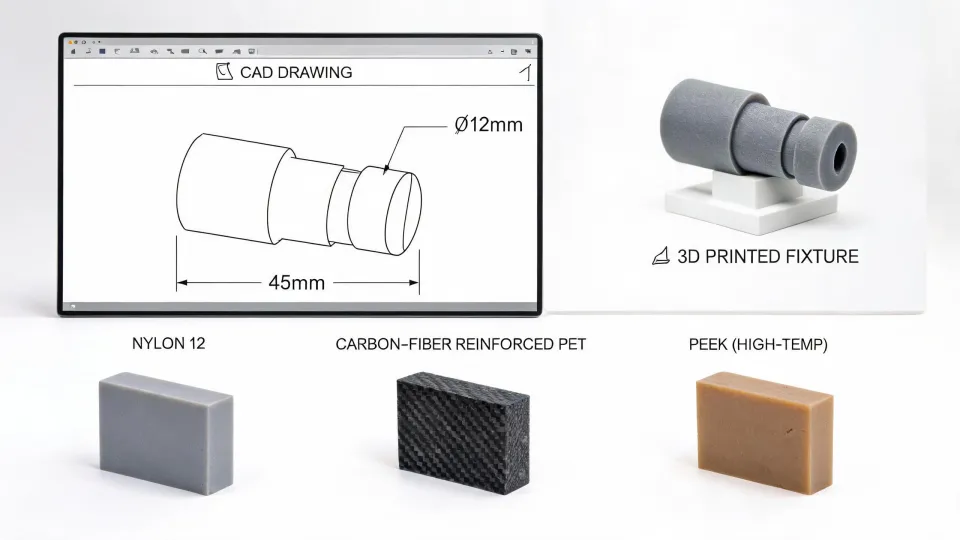
Three years ago, I approved a 3D-printed fixture order. I checked the dimensional callout, signed off, and sent it to the service. The parts came back looking perfect. But I hadn't checked the material data sheet against the operating temperature. 64 pieces, about $1,700 in material and labor, went straight to the bin. Expensive lesson.
I only believed in material verification after that mistake. Now it's the first line of our checklist.
The laser cutter question that changed my approach
Someone asked me recently, 'Can you cut aluminum with a laser cutter?' That question is more useful than it sounds. The short answer is yes—with a fiber laser and the right setup. A common CO2 laser? No, not for aluminum. The wavelength is reflected, so you're not cutting the metal—you might be damaging the laser tube.
Why does this matter? Because the question behind the question is almost never about lasers. It's about wanting to avoid the cost and lead time of sending parts to a machine shop. I get it. But if you ask only about cutting capability and not about material compatibility, you're setting yourself up for an expensive surprise. The same logic applies to every manufacturing quote.
What I check before ordering parts from any process
When I talk to reaction injection molding manufacturers, I no longer lead with price per unit. I ask about the specific polyurethane grade they'll use, how they'll verify wall thickness before tooling, and what they do if the part warps after demolding. If those details aren't stated, the quote is incomplete.
Same with an aluminum CNC machining parts factory. I once picked a supplier because their quote was 20% lower. The first article passed. Then the second batch showed faint mill marks on every visible face. We hadn't defined the surface finish requirement in writing. That was my fault as much as theirs. It cost a week and a re-run.
Now we use a simple 12-point pre-quote checklist. It includes:
- Material data sheet cross-checked against the part's operating environment.
- Design for manufacturing review—wall thickness, overhangs, draft angle, minimum radii.
- Print/release strategy—for FDM, that means build plate material, bed adhesion, and supports in Cura.
- Vendor inspection points—first-article report, dimensional report, surface finish sample.
- Explicit sign-off line—so 'I didn't know' can't become an excuse.
That list looks boring. It's also the reason we've caught 47 potential production errors in the last 18 months. I'm not guessing at that number—it's in our shared drive, with photos. There's something satisfying about a checklist that actually catches errors. The best part: no more 2 a.m. 'did I confirm that alloy?' panic.
So do I still care about Ultimaker 2 specs?
Yes, but for a narrower reason. According to Ultimaker's official specifications (ultimaker.com), the Ultimaker 2 offers a 223 x 223 x 205 mm build volume and a 0.4 mm nozzle. That tells me whether a part can physically fit and roughly what layer line style to expect. It doesn't tell me if the filament is dry, if the build plate was leveled last week, or if a 4-hour print should be split into two parts for reliability.
In fact, I still search 'ultimaker 2 3d printer specs' when a customer brings one in. The specs help me understand the machine's limits. But the failures I deal with are rarely about the machine's advertised capability. They're about setup, materials, and missed steps before the job starts.
I have mixed feelings about smart manufacturing dashboards. Part of me wants to just press 'print' and watch it work. Another part knows that visibility is what saves us. Ultimaker's Digital Factory, for example, has flagged a failed print at hour 16 so we could restart with a corrected profile instead of discovering it the next morning. That kind of feature doesn't show up in a spec sheet, but it's worth more to me than a slightly higher maximum print speed.
But won't more checking slow you down?
That's the objection I get most. It sounds reasonable: in production, speed matters. But I've seen more delays caused by rework than by reviewing files. A five-minute review in Cura catches an overhang that can't be printed without supports. A material check catches a PETG part that will soften at 75°C. If you skip those steps to save 10%, you're gambling the entire delivery date.
I'm not saying you need a hundred-page quality manual. I'm saying a 12-point checklist is cheap insurance. It's the lowest-cost tool in your shop.
5 minutes of verification beats 5 days of correction.
The uncomfortable truth
There is no single best manufacturing process. I respect people building their own machines. I respect teams that use one process for everything. But I've learned the hard way that the process doesn't affect your total cost as much as how you verify it. Whether you're printing on an Ultimaker, getting quotes from reaction injection molding manufacturers, comparing prices at an aluminum CNC machining parts factory, or asking 'can you cut aluminum with a laser cutter?'—the question is the same.
Are you checking before the job runs, or are you paying to discover the mistake afterwards? Specs define what's possible. Verification determines what actually works.
