There's no single 'right' answer when it comes to choosing between a metal 3D printer and a CNC machine. I've been managing procurement for a mid-sized industrial parts supplier for over six years, tracking roughly $180,000 in cumulative spending on prototyping and low-volume production. The answer depends entirely on your specific situation: part complexity, volume, material requirements, and—most importantly—your total cost picture. Let me break it down into three common scenarios.
Understanding the Core Question: Why This Decision Matters
Over the past six years of tracking every invoice, I've seen my fair share of costly mistakes. One of the biggest? Companies investing in expensive equipment—or outsourcing to a specific process—without a clear understanding of their actual needs. The fundamentals haven't changed: you need the right part, at the right quality, delivered on time, and within budget. But how you achieve that has transformed significantly.
What was best practice in 2020—assuming all metal parts need CNC machining—may not apply in 2025. Metal additive manufacturing has matured. It's no longer just a lab curiosity. It's a real option for production parts. But (and this is a big 'but') it's not a universal replacement for machining.
Three Scenarios: Which One Describes Your Situation?
After comparing dozens of projects across our suppliers, I've found most decisions fall into one of three categories. Figure out which one matches your situation, and the path forward becomes clearer.
Scenario A: You Need One to Ten Complex Metal Parts, Quickly
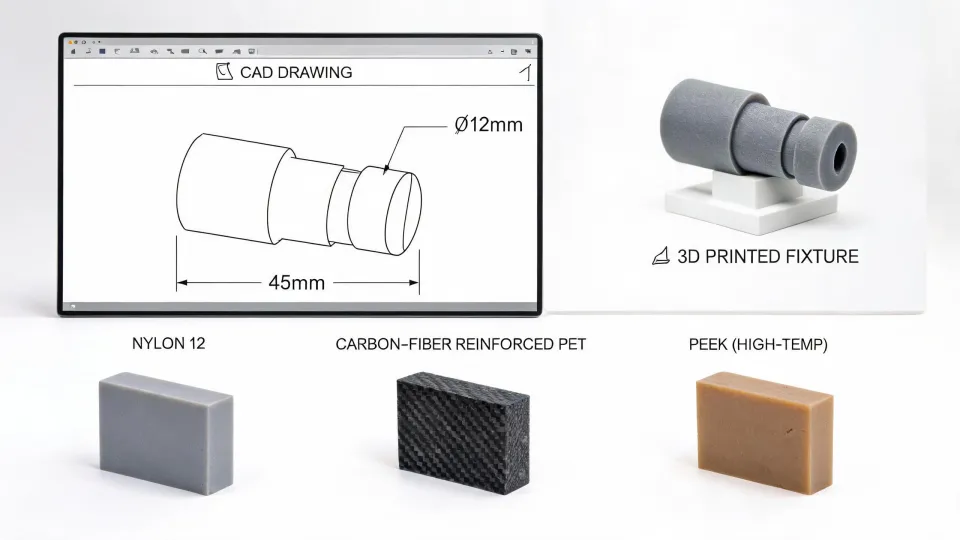
Typical use case: Functional prototypes, custom jigs or fixtures, replacement parts for legacy equipment where tooling is lost.
This is where metal 3D printing shines. Traditional CNC machining for a single complex part requires programming, fixturing, and often multiple setups. For a part with internal cooling channels or complex geometries, machining might take weeks and cost thousands in setup fees alone.
The cost reality: I audited a project where we needed five parts with complex internal geometry. Vendor A (a CNC shop) quoted $2,400 per part plus a $1,200 setup fee. Total: $13,200. Vendor B (a service bureau with a metal 3D printer) quoted $850 per part, zero setup. Total: $4,250. That's a 68% difference hidden in the complexity of the design.
But there's a catch: Metal 3D printing isn't a panacea. Surface finish is often rougher (typically 200-400 Ra vs. 16-32 Ra for machining). If your part needs tight tolerances or a smooth surface for sealing, you'll likely need post-machining. Factor that into your total cost. I made that mistake once (ugh) and it added $600 per part to our bill.
Scenario B: You Need Hundreds to Thousands of Identical Parts
Typical use case: Production runs of standard brackets, housings, or components for a new product line.
This is CNC's home turf. Once the program is written and fixtures are made, machining is fast, repeatable, and cost-effective at scale. The setup cost is amortized over many parts, driving the unit price down significantly.
The cost reality: For an order of 500 parts, the CNC quote was $12 per part after a $1,500 setup fee. Total: $7,500. A metal 3D printing service quote was $28 per part. Total: $14,000. The 3D printing route would have cost nearly double. (Note to self: always run this volume calculation before committing to a process).
One caveat: If your part design is still evolving—you're iterating on the design—3D printing wins on flexibility. You can change the design overnight without expensive re-tooling. Once the design is locked, machining takes over on cost.
Scenario C: You Need Parts, But Don't Care Much About Material Properties
Typical use case: Visual prototypes, conceptual models, non-structural brackets for a static display.
Honestly? Neither metal 3D printing nor CNC may be the right answer here. You're paying a premium for properties you don't need. I've seen procurement managers specify 6061 aluminum parts for a project where a 3D printed PLA prototype would have sufficed (and cost 90% less).
The cost reality: A single aluminum CNC part might cost $150-300. A PLA 3D print of the same geometry? $5-15. If you just need to check fit and form, don't pay for function you won't use. This seems obvious, but you'd be surprised how often this mistake happens when engineers default to 'metal' without questioning if they need it.
If you absolutely need the 'look and feel' of metal, consider metal-coated plastic 3D prints. It's a compromise, but it can save you 70-80% for non-structural applications.
How to Determine Which Scenario You're In
Here's a simple decision tree I use. Answer these three questions honestly:
- How many parts do you need in the next 12 months? Less than 50? Lean toward 3D printing. More than 500? Lean toward machining. Between 50 and 500? It depends on complexity and material.
- How complex is the geometry? Does it have internal channels, undercuts, or lattice structures? That's 3D printing territory. Is it a simple box, bracket, or shaft? Machining will be faster and cheaper.
- What are your tolerance and surface finish requirements? Need +/- 0.001" and 16 Ra? You're looking at machining. OK with +/- 0.005" and a rougher finish? 3D printing could work.
I built this decision tree after getting burned twice on hidden costs. The first time was a complex part I sent to a CNC shop without realizing the setup cost would double my budget. The second time was a simple bracket I 3D printed... only to realize the surface finish was unacceptable and I had to re-machine it anyway. (I still kick myself for that one.)
At the end of the day, the right choice depends on your specific constraints. But one thing I've learned: don't assume the 'traditional' process is always best, and don't assume the 'new' technology is a magic bullet. Run the numbers for your specific case. And if you're unsure, get quotes from both types of service providers. The process of gathering that data will force you to clarify your own requirements (mentally: do this first, before committing to any equipment purchase).
