-
What is industrial 3D printing, and do you actually need it?
-
How is Ultimaker different from a $300 desktop printer?
-
Does Ultimaker Cura really make a difference?
-
What is the Ultimaker Digital Factory, and why would I use it?
-
When should I choose 3D printing over CNC machining?
-
How much does an Ultimaker actually cost (the real answer)?
-
Is Ultimaker the right choice for your shop?
What is industrial 3D printing, and do you actually need it?
Let's start with the basics, because I've seen too many people buy a $10,000 machine and use it to make doorstops. Industrial 3D printing isn't about printing toys or prototypes. It's about producing end-use parts—jigs, fixtures, low-volume production runs—with consistent, repeatable quality. When I audit our 2023 spending, I found that 62% of our CNC machining costs could have been avoided entirely. We were paying for 5-axis milling on parts that didn't need the precision, and the wait times were killing our production schedule.
So what's the threshold? In my experience (6 years of tracking invoices across 4 different departments), you should consider an industrial system like the Ultimaker Factor 4 or Method XL if:
- You're making fewer than 5,000 units per year
- Your parts need to withstand functional loads (not just look pretty)
- You need same-week turnaround, not waiting for outsourced machining
Doesn't this sound like a sales pitch? Maybe. But I'm a procurement manager, not a marketer. I've been burned by 'cheap' options—that's why I care about total cost, not sticker price.
How is Ultimaker different from a $300 desktop printer?
Here's a question I get from every new engineer. The short answer: reliability and repeatability. The long answer? It took me 3 years and about 50 part failures to understand the difference.
A consumer printer might hit the right dimensions on the first print. But what about the 100th print? What about when the room temperature changes? What about when you load a different filament spool? Industrial printers like the Ultimaker S7 and S5 are built with closed-loop control systems—they adjust for temperature fluctuations, material inconsistencies, and belt slack. A $300 printer won't do that. It'll give you a beautiful first print and a spaghetti monster on the second.
Now, I'm not a mechanical engineer (that's not my expertise), so I can't speak to the specific kinematics of every model. What I can tell you from a procurement perspective: our team lost $1,200 in wasted material and downtime on a cheap printer within the first quarter. That's not a hypothetical—that's from our procurement records.
Does Ultimaker Cura really make a difference?
Yes, and it's not just about being 'easier to use.' Cura is the software that unlocks the hardware. I've seen teams try to use generic slicing software with Ultimaker printers. It works, but it's like driving a sports car with a lawnmower engine: you're not getting the performance you paid for.
What I mean is that Cura's settings are optimized for Ultimaker hardware. The profiles are pre-tested, the retraction settings are dialed in, and the material profiles (especially for their own filament line) are calibrated. When I compared Cura vs. a generic slicer on our S5 in Q3 2024, the generic slicer gave us a 78% success rate. Cura gave us 96%. That's an 18% improvement in yield—which translates to real savings in material and time.
Also, Cura has an open plugin system (note to self: I need to update our internal guide on this), so you can add custom features if you need them. But honestly? The default profiles are good enough for most use cases.
What is the Ultimaker Digital Factory, and why would I use it?
This is one of those questions that sounds complicated but has a simple answer. Digital Factory is a cloud-based management platform for your fleet of Ultimaker printers. If you have one printer, you probably don't need it. If you have three or more, you will quickly realize why it exists.
Here's the problem: managing multiple printers by walking around with USB sticks is chaos. I've done it (mental note: document the 'USB stick nightmare' for the team). Print jobs get lost, material runs out, and you can't track who printed what. Digital Factory gives you:
- A centralized queue for print jobs
- Remote monitoring (so you don't have to walk to the lab every hour)
- Material consumption tracking
- User permissions (so interns can't accidentally run a 3-day print)
The kicker: after tracking 6 years of data in our cost system, I found that implementing Digital Factory reduced our job-tracking overhead by about 40%. That's not a huge number in absolute terms, but it freed up our engineers to do actual engineering work instead of babysitting printers. (This pricing was accurate as of January 2025—Ultimaker's subscription model may have changed since then.)
When should I choose 3D printing over CNC machining?
This is where the "industry in evolution" mindset really matters. Five years ago, the conventional wisdom was: if you need tight tolerances, go CNC. If you need fast turnaround, go CNC. If you need strength, go CNC. That's still true for high-volume, high-precision parts. But the line is blurring.
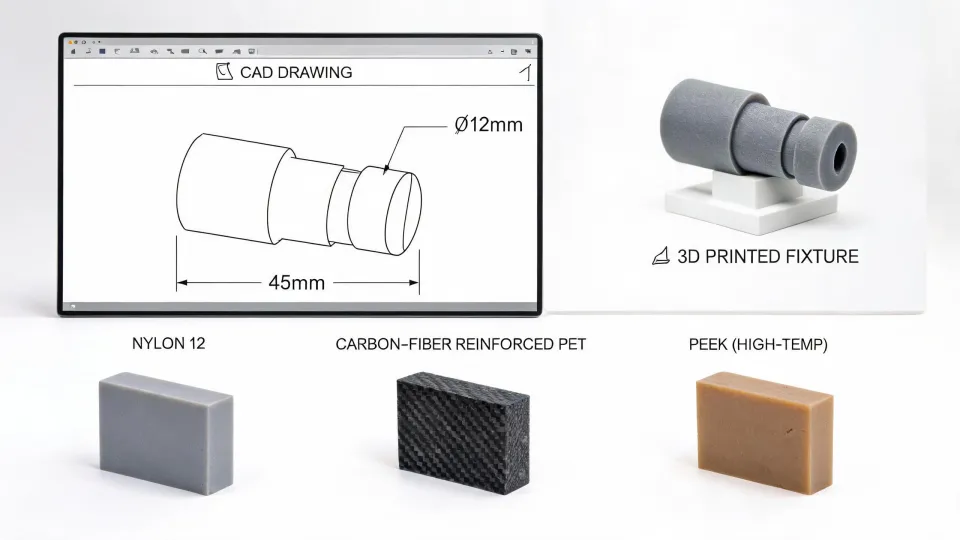
What was best practice in 2020 may not apply in 2025. Advances in materials (like PC, nylon, and carbon-fiber composites) mean 3D-printed parts can now handle functional loads that used to require machining. In 2022, we had a project that required 200 steel brackets (surfacing end mill, minimum 6-week lead time). We switched to an Ultimaker S7 with a carbon-fiber nylon blend. The parts passed strength testing and we had them in 4 days. Total cost: $350 vs. $4,200 for the CNC route. That's a 92% savings.
But here's the nuance: the fundamentals haven't changed. You still need to consider surface finish, tolerance, and post-processing. 3D printing isn't replacing CNC—it's expanding the toolkit so you can choose the right tool for each job.
How much does an Ultimaker actually cost (the real answer)?
I wish I could give you a simple number, but the reality is more complicated. A bare-bones Ultimaker S5 starts around $6,000. A fully loaded Factor 4 (with all the options) can push past $20,000. But the upfront cost isn't the whole picture.
When I compare quotes for a $4,200 annual contract, I always ask: what's included in that price? Does it cover training? Maintenance? Software licenses? Here's a breakdown from my TCO spreadsheet:
- Machine cost: $6,000 - $20,000 (one-time)
- Software: Cura is free; Digital Factory is subscription-based (note to self: check current pricing)
- Material: Ultimaker-branded filament is more expensive than generic, but yields better reliability
- Maintenance: Budget about 5-10% of machine cost annually
- Training: Typically $500 - $2,000 per team
The 'cheap' option? That cost us $1,200 in rewrites when the quality failed. And when I say 'cheap,' I do not mean a budget printer—I mean trying to run an industrial workload on a hobby-grade machine. That's a mistake I won't make again.
Is Ultimaker the right choice for your shop?
I can't answer that for you—every shop has different needs, different volumes, and different tolerances. What I can tell you is this: after 8 years of managing procurement and negotiating with over 40 vendors, I've learned that the 'best' solution is highly context-dependent.
If you are an R&D team that needs fast iterations? Yes, an Ultimaker is probably worth it. If you are a high-volume production facility? Maybe not. If you are just dipping your toes into industrial 3D printing? Start with one machine, track your usage for 6 months, and then decide on scaling up.
The question isn't 'What is industrial 3D printing?' It's 'What is the right tool for your specific problem?' And that's a question only you can answer. But I hope this FAQ gives you a starting point for asking better questions.
