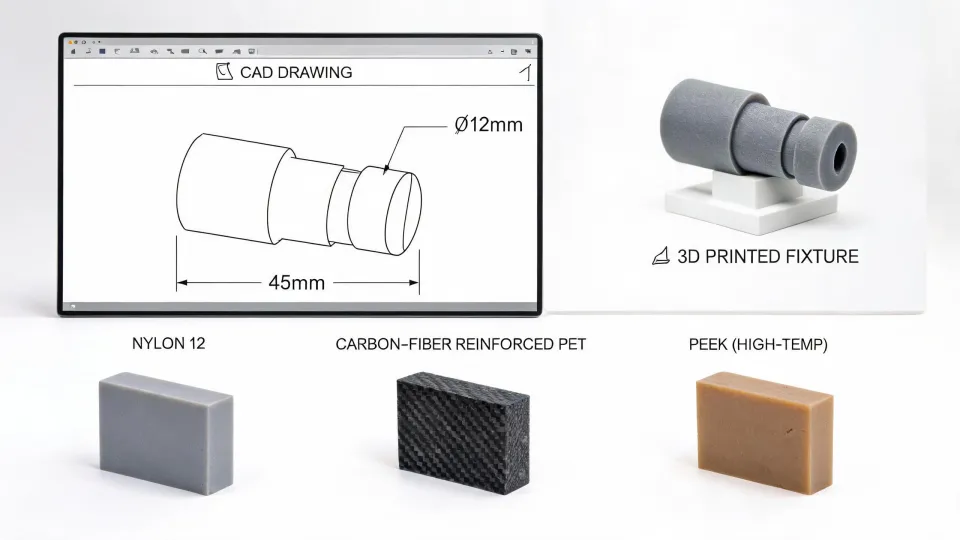
In my role coordinating quick-turn production at a contract manufacturing shop, I've handled more than 200 rush orders over the last eight years. Same-day turnarounds, weekend calls, recovered deadlines—I've seen the pattern. The question I get from engineers and production managers is almost always the same: should we buy an Ultimaker S7 3D printer, or should we keep using CNC machining?
CNC milling precision is the benchmark everyone says they need, and the Ultimaker S7 looks like a serious tool. But my honest answer is not a slogan: it depends. There is no universal winner. I wrote this to help you find the answer for your specific situation.
A quick history lesson before we compare
Before we compare, let's clear up one question: when were 3D printers available to the public? The answer depends on what you mean. The first commercial SLA machines appeared in the late 1980s after Chuck Hull's work on stereolithography, but they were industrial tools with industrial budgets. The more practical date is around 2009, according to the commonly cited patent timeline. That's when key FDM patents began to expire and the desktop 3D printer market started to grow.
Why does this matter? Because a lot of the confusion about Ultimaker comes from that hobbyist history. The Ultimaker S7 3D printer is not a hobby machine. It's a professional platform. But it is still an FDM 3D printer, not a CNC mill. These are different ways of making parts, and precision is not a single number.
Three scenarios, three different answers
Here's how I think about it. I'll describe three scenarios. Find the one that sounds like your job.
Scenario 1: Metal parts, tight tolerances, or production quantities over 1,000
If you need aluminum or steel parts with tight tolerances, use CNC milling. CNC milling precision is the benchmark for machined parts for a reason: the tool cuts away material from a solid block, so you get predictable dimensions, good surface finish, and no layer lines. An Ultimaker S7 can print polymer prototypes, but it will not match machined metal. I don't have hard data on industry-wide production splits, but in our shop, roughly 70% of production metal parts go to CNC. Printing is for prototypes, fixtures, and some polymer parts.
Scenario 2: Functional polymer prototypes and fast iteration
If you need a durable polymer part in 48 hours, and you want control over the iteration loop, the Ultimaker S7 3D printer can be the right choice. The counterintuitive part is that its value is not more precise than CNC. The value is speed to first part. You can start a print in your own building, adjust the CAD, and print again the same day. With CNC, you're waiting for quotes, setup, and machine time.
Be careful, though. I knew I should verify the material profile before starting. Instead, I thought, we've run this filament before, how different can it be? It was different. The parts warped overnight, and we lost a day. The printer didn't fail; my process did. That's the real risk with a professional printer: it makes printing easy enough that you forget to do the boring checks.
Scenario 3: Complex internal geometry or design uncertainty
If you need internal cooling channels, lattice structures, or a one-off part with geometry that a CNC tool can't reach, 3D printing wins. The surprise wasn't the cost saving. It was how much earlier the design team could test multiple versions. With CNC, every design change is expensive. With the S7, a design change is just another print. That said, this doesn't mean you should 3D print everything. If the part is simple, flat, metal, or high volume, CNC is faster and cheaper.
The scenario people don't expect: when not to buy an Ultimaker S7
Here's the part that surprises people. I'd rather send work to a CNC shop than force a 3D printed solution. A vendor who says this isn't our strength earns my trust for everything else. We regularly refer clients to local machine shops when milling is the right process. We don't lose respect for that. We lose respect when we pretend every problem is a 3D print.
Same with anything outside my specialty. If someone asked me about CoolPeel CO2 laser resurfacing in Lakeland, I'd say that's outside my lane. Ask a qualified medical provider. The point is that expertise has boundaries. The same mindset that keeps me from recommending a laser clinic also keeps me from promising that an Ultimaker S7 can replace CNC milling precision. Per FTC business guidance on advertising and marketing (ftc.gov), a claim like that would need to be truthful and substantiated. Honestly, I couldn't substantiate it.
What about the Ultimaker 3D printer price?
I'll be blunt: I don't have up-to-date price sheets in front of me, so I won't quote a number. The Ultimaker 3D printer price is a common question, but the real question is value. The S7 is priced as a professional tool. If you need a printer for occasional desk toys, that price is hard to justify. If you need reliable polymer parts across multiple shifts, a properly calibrated S7 can pay for itself by reducing failed prints and wasted time.
I wish I had tracked our failure rate before and after switching to a more professional system. I don't have hard data. Anecdotally, the difference was bigger than I expected. There's something satisfying about a first good print, but the consistent tenth print is what actually pays for the machine.
How to decide in the next ten minutes
When I'm triaging a rush job, I run through a short list:
- Material: metal or polymer?
- Quantity: one part, ten parts, a thousand?
- Tolerance: what's the acceptable range?
- Deadline: is it needed this week or this quarter?
- Process: can you run it in-house, or do you need an outside shop?
If the answer is metal, high quantity, and tight tolerance, use CNC milling. If it's polymer, low quantity, and fast turnaround, use the Ultimaker S7 3D printer. If it's both, you need both. The worst decision is forcing one process to solve every problem.
Conclusion: the answer I've landed on
So when were 3D printers available to the public? Practically speaking, the late 2000s, when the desktop market took off. But the more useful answer is that 3D printing became genuinely useful when we stopped treating it as a magic box. The Ultimaker S7 is a good example of a serious 3D printer, but it's a specialist tool. CNC milling precision is a different specialist. And in a world where deadlines are always urgent, the right process is the one that gets your part to you with the least risk. Not the one that sounds most advanced on paper. That's the answer I've landed on after 200+ rush orders.
