Let's cut through the marketing for a second. I've been managing our company's additive manufacturing budget for over six years now—tracking every spool of filament, every print failure, every hour of maintenance. When I see a headline claiming a 3D printer is the "best" for on-demand manufacturing, my first question is always the same: for who?
The Ultimaker S5 is a $6,000+ machine before you add anything else. That's not a casual purchase. It's a line-item that gets scrutinized. So after auditing $180,000 in cumulative spending across our department, I can tell you there is no universal answer. The S5 is either a fantastic investment or an expensive paperweight, depending entirely on your scenario.
Here's how I break it down, based on actual procurement decisions we've made.
Scenario 1: The Emergency Part (Where the S5 Shines)
I still kick myself for our first big emergency. A critical conveyor belt sensor bracket snapped on a Thursday afternoon. Production line downtime was costing us roughly $4,200 an hour. The OEM quoted a replacement at $180, with a 10-day lead time. We scrambled, paid $600 for overnight machining from a local shop, and got the part by Friday evening. Total lost production: about 8 hours. Total cost of that broken bracket: over $34,000.
Now? We have an Ultimaker S5 with a dedicated spool of Tough PLA. That same bracket can be designed and printed in under 4 hours. The material cost is about $3. The machine is ready to go. The cost of that part, including machine amortization, is maybe $15.
This is the core of the time certainty premium. In March 2024, we paid $400 extra for rush delivery on a specialty filament from a different vendor. The alternative was missing a $15,000 production deadline. Was the filament itself overpriced? Yes. Was it worth it? Absolutely.
"In an emergency, you aren't paying for speed. You're paying for certainty. And uncertain cheap is always more expensive than certain expensive."
If you have a production line that stops, or a critical system that can't wait for a courier, the S5's reliability makes it a no-brainer. We've printed everything from custom nozzle adapters to end-of-arm tooling jigs. The Cura software integration (which, honestly, we initially hated) allows for predictable print times. You know exactly when the part will be done. No guesswork.
Scenario 2: The Production Jig (Where It Can Pay for Itself—Slowly)
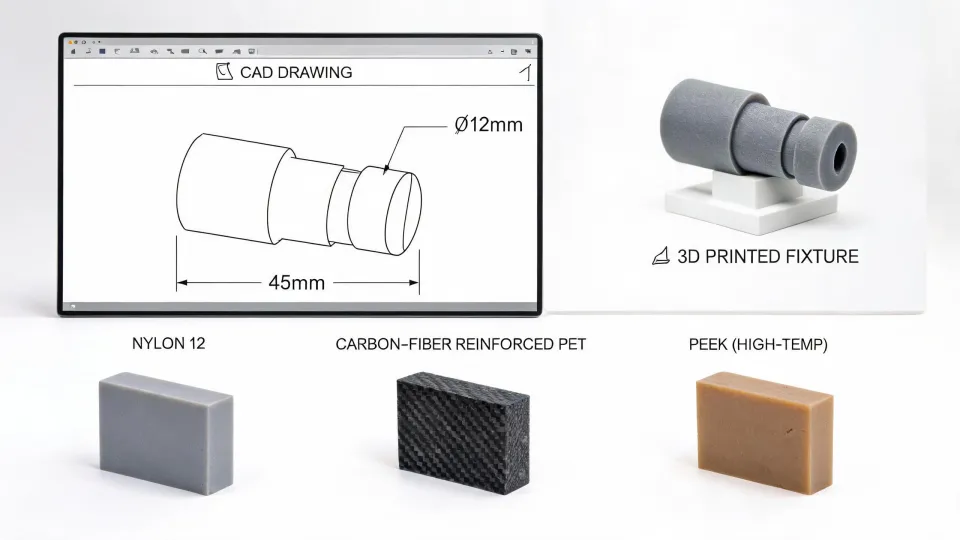
This is where the math gets trickier. We have a regular need for custom assembly jigs. They're not complex, but they're specific. The old way: pay a local shop $60-80 per jig, wait 3-5 days. The new way: print them on the S5. Material cost per jig: about $4.
Sounds great, right? The problem is volume. We need about 15 jigs a quarter. The S5 costs roughly $1,500 per year in maintenance and electricity (not including the initial purchase). Even factoring in the material savings, the payback period on a $6,000 printer is over 3 years.
Does it still make sense? Yes, but not for the reasons you might think. The value isn't just in the cost savings per part. It's in the iteration speed. We can design a jig, test it, find a flaw, fix it, and re-print the same day. That cycle used to take a week. The speed of development is a hidden saving that rarely shows up on a P&L sheet.
I only believed this after ignoring it. For the first year, we tracked only direct per-part costs and thought the machine was a waste. It wasn't until I sat down and calculated the engineering time saved—about 40 hours per quarter—that the numbers flipped. That's where the S5 earns its keep.
Scenario 3: The Prototype Run (Where You Should Probably Look Elsewhere)
Here's the one that goes against the grain. For rapid prototyping of complex geometries with iterative design changes—think highly aesthetic parts or intricate mechanical assemblies—the S5 has limits. The FDM layer lines, while excellent, still require post-processing for a professional finish. The build volume (330 x 240 x 300 mm) is good, but not enormous.
If your need is purely rapid prototyping for visual models or fit-checks on complex parts, a resin-based SLA printer or even a faster FDM machine like a Bambu Lab X1 Carbon (not that we'd name names) might be a better fit. They're often cheaper upfront and print faster, albeit with different trade-offs on reliability and material cost.
The Ultimaker S5 excels in production, not just prototyping. Its strength is the repeatability. We can print a jig today, and the exact same jig six months from now, with identical quality. That consistency is something you pay for. And that consistency is what makes it a tool for manufacturing, not just a toy for the R&D lab.
How to Decide What You Actually Need
Here's the simple test. Grab a spreadsheet. List your answers:
- How often do you have emergencies? If you have a production line that stops even once a quarter, the S5 is amortized by the second emergency.
- How many jigs/fixtures do you need per year? Over 50? The S5's material efficiency becomes a major plus. Under 20? Look at the hidden value in iteration speed.
- Do you need repeatable, production-grade parts? If your parts just need to look good for a presentation, buy a cheaper, faster machine. If they need to work under stress, buy the S5.
I almost went with a cheaper machine to save $4,000 on our initial investment. That machine had a 30% failure rate on complex prints. The 'cheap' option resulted in a $1,200 redo when a critical part failed halfway through a 12-hour print. The S5's failure rate is... well, let's just say we can count the catastrophic failures on one hand over two years.
So glad I didn't go cheap. Sometimes, you pay for reliability. And in the industrial world, reliability is the only currency that matters.
