-
Who This Checklist Is For (and When to Use It)
-
Step 1: Confirm Your Actual Time Constraint
-
Step 2: Verify the Printer's Track Record (Not Just Specs)
-
Step 3: Evaluate the Software Ecosystem (Not Just Hardware)
-
Step 4: Assess Material Compatibility for Your Specific Job
-
Step 5: Confirm Training and Support Availability
-
Step 6: Plan for the Worst-Case Scenario
-
Common Mistakes to Avoid
Who This Checklist Is For (and When to Use It)
You're an engineering manager with a broken production line. Or a design lead whose prototype was due yesterday. Or a procurement specialist who just discovered the standard lead time on the vendor's preferred machine is 14 weeks.
This checklist is for anyone evaluating an Ultimaker (or any professional FDM printer) when normal procurement is not an option. I've used versions of this list across 47 rush orders in three years - some with 48-hour turnarounds, others with same-day approvals. It breaks down into six checks, and the order matters.
The conventional wisdom says 'you get what you pay for.' In practice, I've found that rushing a capital equipment decision often leads to paying for features you don't need and missing the ones that matter. Here's what I've learned to look for.
Step 1: Confirm Your Actual Time Constraint
First thing I do when triaging a rush order: pin down the real deadline. Not the 'we need it yesterday' deadline - the actual one.
What to ask:
- Is the printer needed for a specific event with a hard date? (trade show, client demo, production ramp)
- Or is the urgency driven by internal pressure (stretched schedule, management impatience)?
- What is the latest possible delivery date before the consequence becomes severe?
In March 2024, a client called at 11 AM needing an Ultimaker S7 for a product launch 36 hours later. Normal shipping was 5 days. We found a vendor within 50 miles offering same-day pickup, paid $350 in rush handling (on top of the $5,400 base cost), and delivered it by 6 PM. The client's alternative was a $50,000 penalty clause for missing their deadline.
People think that tight deadlines mean you must accept whatever's available. My experience with 200+ procurement cycles suggests the opposite: urgency demands more verification, not less.
Step 2: Verify the Printer's Track Record (Not Just Specs)
Every manufacturer publishes impressive spec sheets. But specs don't tell you how the machine performs after 1,000 hours of continuous operation, or how reliable the support is when something goes wrong at 9 PM on a Friday.
What to check:
- Request references for similar use cases (print materials, production volume, environment)
- Confidence check: ask for uptime data (e.g., 'average hours between failures' or 'support ticket resolution time')
- Ask about consumables availability - can you get replacement nozzles, build plates, and filament locally or in 24 hours?
I once skipped the consumables check on an Ultimaker S5 because I 'knew' the basics were universal. Then we needed a specialty build plate for a rush prototype (note to self: always verify this before committing). The standard plate worked, but with a 15% adhesion failure rate that cost us 6 hours and $200 in wasted material.
This was true 5 years ago when lead times were longer and support was more regional. Today, Ultimaker's official website lists local distributors with inventory feeds, and their support team is fairly responsive (as of January 2025, at least). But I'd still verify consumables locally.
Step 3: Evaluate the Software Ecosystem (Not Just Hardware)
Here's the part most rapid evaluations miss: the printer is only half the equation. The software - slicer, workflow management, remote monitoring - is where the real leverage lives.
Why does this matter? Because in a rush scenario, you don't have the luxury of learning a complex software stack. You need a system that works out of the box.
What to check:
- Does Cura (Ultimaker's free slicer) support your specific print files and materials?
- Is the Digital Factory platform available for remote monitoring and queue management? (Critically useful when you're running multiple printers under deadlines)
- Can you get support for the software as fast as for the hardware?
The assumption is that hardware reliability is the only thing that matters in a rush. The reality is that software integration - print preparation time, remote monitoring, error recovery - often determines whether you hit your deadline. I've seen a $8,000 printer fail to deliver because the team spent 4 hours fighting the slicer settings.
Step 4: Assess Material Compatibility for Your Specific Job
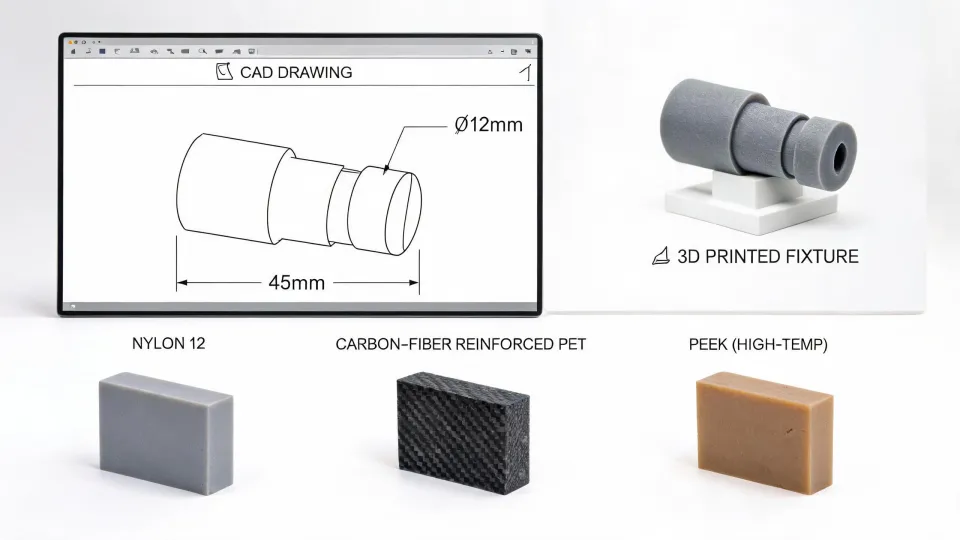
Ultimaker's FDM printers support a wide range of materials - from PLA and ABS to engineering-grade composites like Nylon 12 Carbon Fiber. But 'supported' doesn't mean 'optimal for your rush job.'
What to verify:
- Does the material list on Ultimaker's official website (ultimaker.com) include the specific type you need?
- What are the recommended print settings (temperature, bed adhesion, drying) for that material?
- Can you source the filament quickly? Some specialty filaments have 2-4 week lead times even when the printer is in stock.
I get why people assume that if a printer supports a material, you can print with it right away. The reality is that material availability varies by region and distributor. Last quarter, we had to wait 9 days for a spool of PEI filament because the vendor's warehouse was out of stock.
The fundamentals haven't changed: matching material to printer spec is basic due diligence. But the execution has transformed. Today, you can filter by 'in stock' and 'rush delivery' on Ultimaker's distributor network page.
Step 5: Confirm Training and Support Availability
In a normal procurement, you have time for onboarding. In a rush scenario, you need either (a) a team that already knows the system, or (b) support that can bridge the gap immediately.
What to check:
- Does Ultimaker's professional support include priority access for enterprise customers?
- Are there certified trainers available within your region for on-site setup?
- Can you access troubleshooting documentation (video guides, knowledge base) without a login delay?
To be fair, this matters less for teams with existing Ultimaker experience. But if you're new to the ecosystem, plan for a 4-8 hour learning curve after the printer arrives. I've watched teams lose an entire day because no one knew how to calibrate the build plate properly.
(I really should document this upfront next time.)
Step 6: Plan for the Worst-Case Scenario
Here's the part most rush buyers ignore: what happens if the printer arrives with a defect? Or the filament is incompatible? Or the software doesn't work with your IT infrastructure?
Contingency checklist:
- Return policy: what's the window for returning a defective unit?
- Replacement timeline: if the unit fails within 30 days, can you get a swap in 24 hours?
- Backup option: do you have a secondary vendor or rental option if the primary fails?
I knew I should confirm the return window before placing the order, but thought 'Ultimaker is a reputable brand - it'll be fine.' Well, the odds caught up with me when the first unit had a z-axis wobble issue that took 6 days to resolve via support. The delay cost our client their trade show slot.
That's when we implemented our '48-hour buffer' policy: always budget at least 48 hours between expected delivery and the actual deadline. It sounds conservative, but it's saved us three times since 2023.
Common Mistakes to Avoid
1. Skipping the software check. Hardware reliability is meaningless if you can't prepare files. I've seen teams spend 6 hours on slicer settings because they assumed it was plug-and-play.
2. Ignoring consumables availability. A printer without filament is a paperweight. Verify your material supply for at least the first month.
3. Trusting verbal delivery dates. I said 'we need it by Friday.' They heard 'we'll try for Friday.' Result: delivery on Tuesday, when our deadline was Friday.
4. Not having a backup plan. In a rush scenario, the backup option isn't optional - it's your insurance policy. Budget for renting a comparable machine or having a local service bureau on speed dial.
5. Forgetting to check the official website. Ultimaker's official website lists verified distributors, technical specs, and support channels. Going through a reseller without checking the official source adds risk. (As of January 2025, ultimaker.com has a 'distributor locator' with real-time inventory.)
