Why I Changed My Mind About 3D Printing
I'm the office administrator for a 150-person engineering company. I manage all prototype and small-batch manufacturing procurement—roughly $200,000 annually across 8 vendors. When I first took over in 2020, I assumed outsourcing was always the smarter move. No capital outlay, no maintenance headaches. Just send a file, get a part.
Then three budget overruns and a string of late deliveries made me reconsider. This article walks you through the comparison between bringing an Ultimaker S7 3D printer in-house (paired with the Ultimaker Factory platform) and sticking with external shops. I'll cover three dimensions: cost, speed, and control. No fluff, just what I learned the hard way.
Cost: The Truth About Total Ownership
My initial approach was simple: outsourcing meant I only paid when I needed parts. No idle machine, no filament waste. But after tracking our Q3 2024 data, I saw a different picture.
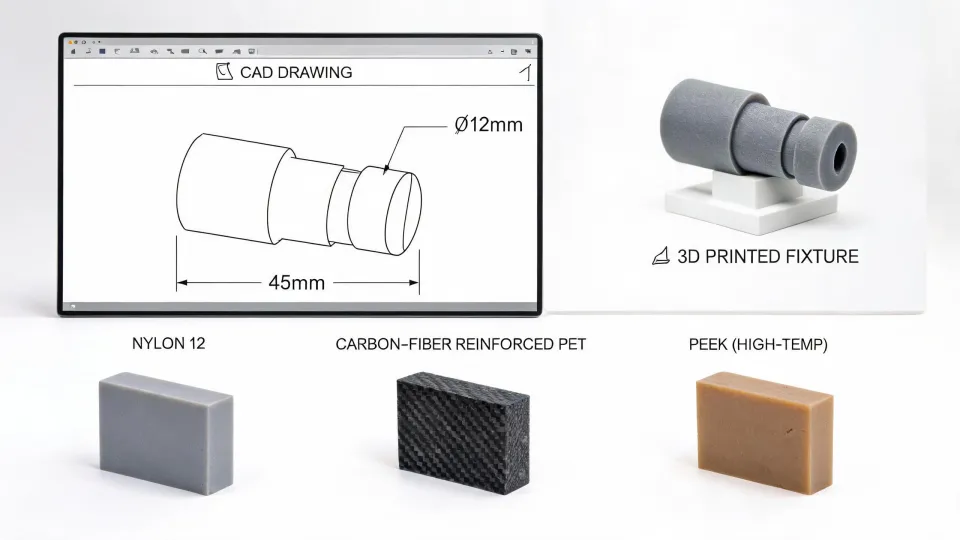
Here's what I found: a typical outsourced prototype from our go-to shop ran between $400 and $1,800 per part, depending on complexity and material. For a laser welding fixture we needed last year, the quote was $1,200. Meanwhile, the Ultimaker S7 prints the same part using a spool of PLA or Tough PLA that costs about $35. Even factoring in the printer's price (about $6,000 as of January 2025) and annual maintenance, we crossed the break-even point after about 25 parts. That was way earlier than I expected.
Plus, there's a hidden cost: rush fees. When a replacement VMC component broke down and our machinist needed a quick jig, the external shop quoted a 2-week lead time unless we paid a 50% premium. We printed it overnight in-house for $12 in material.
"The printer paid for itself in 8 months. I should have run the numbers sooner."
Speed: The Real World vs. Promises
Speed was the game changer. My frustration with external shops peaked when a supplier delivered the wrong laser welding parts—twice. Each iteration added 5–7 days. With the Ultimaker S7, I can modify the STL file and hit print in 20 minutes. A typical prototype goes from finished design to physical part in 4–8 hours.
And yes, I use the Benchy for calibration. If you're wondering "what is a benchy in 3d printing?"—it's a small boat model used to test print quality. I run one every time we switch materials. It catches issues like overhangs or stringing before we commit to functional parts. That single test saved us from printing a wasted batch of fixtures twice in the last quarter.
Comparison: outsourced turnaround averaged 8 business days for new parts. In-house: same day if started before 3 PM. The difference was even bigger with complex geometries—external shops would take extra time for support removal and cleanup.
Quality and Control: The Real Cost of Mistakes
The most frustrating part? Communication gaps. I'd send a detailed technical drawing, and the vendor would interpret tolerances differently. After the third time a supplier delivered parts with incorrect thread pitches, I was ready to pull the trigger on an in-house printer.
With the Ultimaker S7, I have full control over layer resolution (down to 0.25 mm), infill density, and orientation. We use the Ultimaker Factory platform to manage print jobs across teams—it tracks material usage, predicts completion times, and sends alerts. That level of oversight is impossible with external shops.
But here's the honest part: in-house printing isn't perfect. Print failures happen. A clogged nozzle cost us a day last month. And some geometries (like thin walls or very large parts) still go to local machine shops. Bottom line: we're not replacing all traditional manufacturing. We're complementing it.
When to Choose Each Option
So here's my rule of thumb after two years of hybrid sourcing:
- Bring in-house (Ultimaker S7) when: you need quick iterations, custom jigs and fixtures, functional prototypes under 250×200×200 mm, or small batches of parts with standard materials (PLA, PETG, TPU, PC).
- Outsource when: you need metal parts, very high precision (sub-0.1 mm), exotic materials (PEEK, Ultem), or quantities over 100 units.
The Ultimaker S7 sits perfectly in the gap between "just a hobby printer" and "industrial CNC replacement." It's not for everything, but for the 70% of our prototype needs, it's been a huge win. I still buy some parts from outside vendors, but now I have leverage—I can say "if you can't do it in a week, I'll print it myself."
If you're an admin buyer like me, struggling with supplier reliability or hidden rush costs, run the numbers on a dedicated Ultimaker S7. You might be surprised. I know I was.
