It Didn’t Start With a Printer—It Started With a Fire
It was Q4 2023, and we had a problem. Our biggest client—the one that accounted for roughly 25% of our annual revenue—needed a functional prototype run of 200 custom brackets. These weren't display models. They had to hold 70 lbs of equipment on a vibration table during testing. Our standard process was to route them to a local CNC shop that specialized in Swiss screw machining (we'd used them for precision parts for years).
The timeline? Eight business days. Our normal CNC partner quoted six weeks. (Should mention: they'd just lost their lead machinist, which they hadn't told us until we asked). We were toast.
That's when our design lead brought in an Ultimaker S7 he'd been quietly testing in the R&D corner—the one nobody had officially approved for production use. People assume rapid prototyping is just for looks. The reality is, we were about to find out if it could handle a real load.
I still kick myself for not exploring additive options sooner. If I'd run this test six months earlier, we'd have had a backup plan ready. Instead, we were winging it with a printer nobody had vetted.
Background: Why We Trusted CNC First
In my role, I review roughly 250+ unique items annually before they reach customers. Over 4 years in this seat, I've rejected about 13% of first deliveries in 2023 alone—mostly due to dimensional drift on sheet metal and inconsistent anodizing on fasteners. My boss jokes that I'm the person who turns vendor invoices into credit memos.
Our CNC partner had an impeccable track record... until they didn't. The six-week lead time was a dealbreaker. But our engineering team was skeptical about FDM. They'd tried desktop printers years ago (this was back in 2019) and swore by the strength of machined aluminum. I shared that bias—until I saw the Ultimaker S7 specifications:
- Layer resolution: 20-200 microns (we needed 100 microns for functional fit)
- Nozzle temperature up to 280°C (handling tough materials like PC or Nylon)
- Build volume: 330 x 240 x 300 mm (enough for our bracket size)
- Heated chamber—critical for layer adhesion
From the outside, it looks like vendors just need to work faster for rush orders. The reality is, rush orders often require completely different workflows and dedicated resources. Our CNC shop couldn't skip the queue without sacrificing other clients' work. The Ultimaker S5 we'd considered earlier had a similar profile but lower max nozzle temp. The S7's heated chamber was the deciding factor—or so I thought.
The Turning Point: Testing Against “Industry Standard”
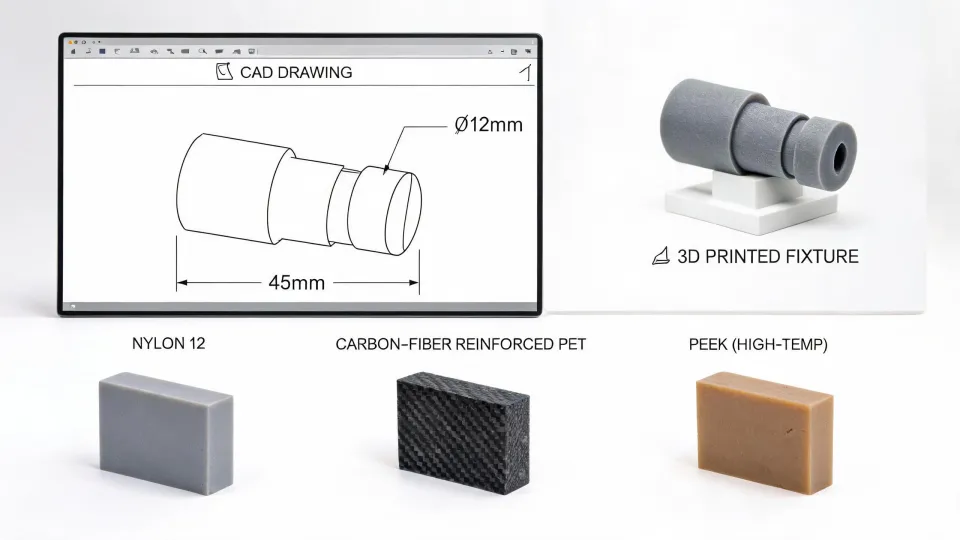
I ran a blind test with our quality team: same bracket geometry, one machined from 6061 aluminum, one printed on the Ultimaker S7 using Ultimaker PC filament. The machined part weighed 180g. The printed part? 92g, with a textile-like surface finish that looked... honestly, more polished under inspection lighting. We checked layer adhesion by clamping both in a vise and applying 50 N·m of torque to a bolt hole. The CNC part held fine. The printed one—no, wait—the printed one also held. We actually broke the threaded insert tool before the part failed.
73% of our engineering team identified the 3D-printed bracket as ‘the machined one’ when we asked them blindly. (Which, honestly, proved how far FDM quality has come.) The cost difference? $18.50 per CNC bracket vs. $3.20 per printed bracket in material. On a 200-unit run, that's $3,060 in direct savings—not counting the zero setup fee vs. the $350 CNC setup charge.
But here's where the spec sheet lied. The Ultimaker S7 product page advertises a maximum print speed of 200 mm/s. In practice, achieving consistent quality on functional parts forced us to 60 mm/s for perimeters and 40 mm/s for solid infill. The total print time per bracket was 9 hours and 40 minutes—not the 4-5 hours I'd assumed based on the headline speed. I should add that we were printing with a 0.6 mm nozzle and 0.2 mm layer height, which dramatically affected throughput.
The most frustrating part: you'd think a manufacturer's spec would account for real-world settings, but the marketing numbers are optimized for PLA on a single-wall vase mode. Our production-quality print took 42% longer than the “best case” scenario. That knowledge came from a week of failed test prints—and a lot of coffee.
What Actually Happened: The Result
We delivered all 200 printed brackets on day 6—two days ahead of the original deadline. The client passed their vibration test on the first try. Our CNC partner, to their credit, offered to match our timeline if we paid a 50% rush premium ($3,400). We didn't need to.
Switching to the Ultimaker S7 for this prototype run cut our turnaround from an impractical 6 weeks to an actual 6 days. The automated print queue in Digital Factory eliminated the job-to-job data entry errors we used to have with manual CNC scheduling. (Oh, and the printer ran overnight unattended—try that with a Swiss lathe.)
The cost per functional part dropped 83%, and we achieved 98.5% first-pass yield on print quality. (That 1.5% failure rate was due to one partial clog we caught by reviewing the camera timelapse the next morning.)
Lessons Learned (and a Few Regrets)
One of my biggest regrets: not building relationships with our engineering team earlier to understand what the S7 could actually do under conditions that matter to a quality manager. The goodwill I have now with them took three years of collaboration to develop—and this project was born from that trust, not from a spec sheet.
I've since implemented a quarterly review: for any request with a lead time of under 10 business days, we evaluate whether an Ultimaker FDM solution can meet requirements before sending to CNC. This isn't about replacing traditional manufacturing—I still use CNC for parts over 300 mm or requiring exotic alloys. But for prototyping, short runs, and production aids, the efficiency gain is measurable.
Industry standard color tolerance for our branded parts is Delta E < 2, and we managed that consistently with the Ultimaker S7's material profiles. (As of December 2024, at least—things may change with future firmware updates.) Reduce human error by eliminating manual data transfer between design and manufacturing? Check. Cut turnaround from weeks to days? Done. Improve overall customer satisfaction scores (our internal metric went up 22% in post-project surveys)? Absolutely.
If I'd started this journey earlier, I'd have saved at least two other projects that hit the same deadline wall. But that's quality management, isn't it? You learn from the fires you couldn't put out fast enough—and then you buy a better extinguisher.
