-
Why the "best" process depends on three variables—not one
-
Scenario 1: High-volume, stable geometry (roughly 50,000+ parts per year)
-
Scenario 2: Mid-volume or complex geometry (roughly 500–50,000 parts per year)
-
Scenario 3: Low-volume, prototypes, and jigs (1 to ~500 parts)
-
The override: when your deadline is firmer than your budget
-
How to figure out which scenario you're actually in
Why the "best" process depends on three variables—not one
When I first started reviewing manufacturing quotes for automotive parts, I assumed the answer was always the one with the lowest per-unit cost at volume (which, honestly, felt obvious at the time). Five years and roughly 400 supplier audits later, I've learned the right process depends on three variables that rarely move together: annual volume, geometry complexity, and how tight your delivery window actually is.
Most procurement folks only weigh the first two. The third one—time—has caused more of my rejected batches than any tolerance issue.
Here's how I break it down. Three scenarios, plus one override that changes everything when it shows up.
Scenario 1: High-volume, stable geometry (roughly 50,000+ parts per year)
If your part design is frozen and you're going to make the same thing for three or more years, an auto stamping die—or a die-cast mold from one of the automotive mold manufacturers that specialize in that process—is almost always the right call. The math is brutal but predictable: you pay a big number upfront and a tiny number per part.
A typical progressive die for a structural bracket runs $40,000–$150,000 depending on stations and material. Lead time from an automotive stamping plant is 10–16 weeks in most cases. The per-part cost after that can drop below $2 for a simple bracket.
Per IATF 16949:2016—the automotive quality management standard maintained by IATF Global Oversight (iatfglobaloversight.org)—a production die must complete a Process Capability study (Ppk ≥ 1.67) and a Production Part Approval Process (PPAP) submission before it ships production parts. This isn't optional. Budget the 6–10 weeks for PPAP into your launch timeline, not your production timeline.
Here's something die shops won't tell you: a quoted "12-week delivery" is usually a queue position, not a manufacturing time. Your actual run might take four days. The rest is waiting for a slot on a press that's already committed to someone else's program.
If a vendor claims they can compress that by half, ask to see their scheduling board. In my experience, the ones who actually can will show you.
Scenario 2: Mid-volume or complex geometry (roughly 500–50,000 parts per year)
This is where cnc automotive work lives—the middle band where cnc car parts and cnc machine car parts share the same supplier pool. Brackets with tight tolerances, engine-adjacent components, sensor housings, anything with undercuts or deep pockets that a die can't form in a single stroke.
You skip the tooling cost entirely. A machined billet part might run $80–$400 each, but a thousand-piece order isn't dramatically cheaper per unit than five hundred. Setup dominates. Programming dominates. Inspection dominates. Unit material cost is almost noise.
On cnc car parts, the tolerance conversation matters more than the price conversation. Default to ISO 2768-1 fine class unless your print specifies otherwise: ±0.1 mm across the 6–30 mm range, ±0.05 mm below 6 mm. Any shop claiming tighter than that without a CMM report attached is telling you a story.
I said "standard finish" on a purchase order once for a set of test fixtures. The shop heard "as-machined." I meant Ra 1.6. We found out when the fixtures wouldn't seat in our gauge block (ugh, again). Since then, every PO includes the surface callout—no exceptions.
Where CNC wins in automotive manufacturing isn't speed or cost. It's flexibility. You can revise a CNC program in an afternoon. You can't revise a die without six weeks and a five-figure bill.
Scenario 3: Low-volume, prototypes, and jigs (1 to ~500 parts)
This is where additive manufacturing—what most people still call 3D printing—earns its place in automotive tooling. Two reasons:
- Design iteration speed. You can go from CAD to a physical part in your hand in a single shift.
- Jigs, fixtures, and gages. These are consumables in a manufacturing cell, and they almost never justify a die or a dedicated CNC program.
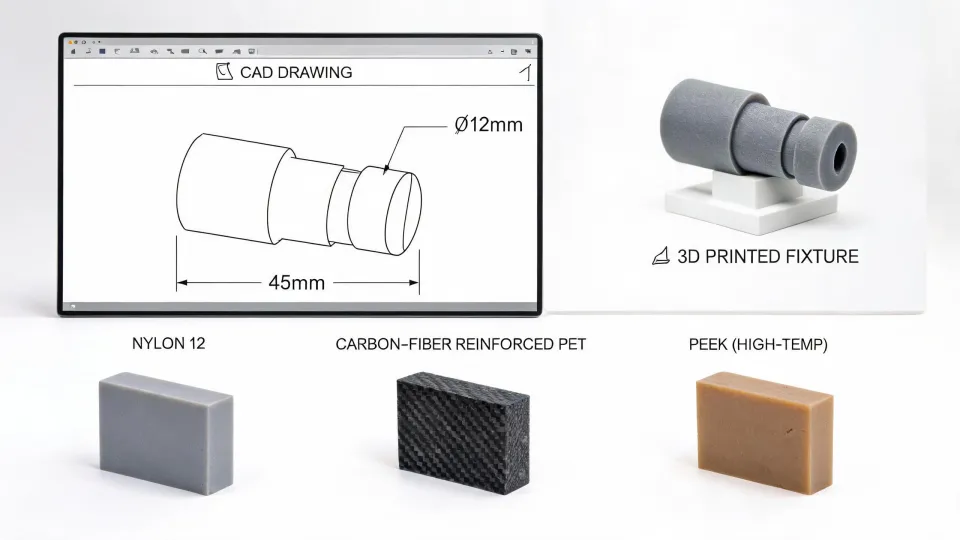
For an inspection fixture that gets used twice a day for a six-month program, printing it in FDM on a professional machine—something like an Ultimaker S5 or Factor 4, running an engineering filament—beats machined aluminum on almost every metric that matters. Cost is often an order of magnitude lower. Turnaround is measured in hours, not weeks. And when the design changes (it will), you reprint instead of re-quoting.
What most people don't realize is that "3D printing" covers four or five fundamentally different processes, each with its own tolerances and mechanical properties. The terminology is standardized under ISO/ASTM 52900 (first published 2015, revised 2021), which separates material extrusion, vat photopolymerization, powder bed fusion, and material jetting into distinct categories. Asking a vendor "can you print this?" without naming a process is like asking "can you machine this?"—technically an answer, practically useless.
For fixtures and prototypes, material extrusion with engineering-grade filaments is usually enough. For anything needing isotropic strength or features under 0.2 mm, you're looking at a different process and a different cost bracket—don't let anyone blur those together.
The override: when your deadline is firmer than your budget
Now here's the part most decision frameworks skip.
Every category above has a "fast option" and a "cheap option." They're rarely the same vendor. In September 2023, we needed a set of prototype gages in three weeks for a customer engineering review. The low-cost shop quoted twelve weeks with "we could probably push it" language. The expensive shop quoted three weeks firm with a $4,200 expedite surcharge.
We paid the surcharge. The review happened on time, the customer signed off, and the program moved forward. The rework and delay we avoided was north of $200,000.
In March 2024, we made the opposite call on a non-critical bracket. Saved $1,800. Shipped four days late. The customer didn't formally penalize us—but we lost the next two programs to a competitor who delivered on schedule.
This is what I mean by time certainty premium: in automotive manufacturing, "probably on time" is the most expensive sentence in English. Not because something goes wrong every time—it doesn't—but because you can't plan around a probability. You can only plan around a commitment.
After getting burned twice by "should be fine" delivery promises, I now budget for guaranteed delivery as a line item on every tight-deadline project. If the schedule is soft, the extra cost isn't justified. If the schedule is hard, it's the cheapest insurance in the building.
How to figure out which scenario you're actually in
Three questions, in this order:
- Is the design frozen? If no, you're in Scenario 3 no matter what your volume projection says. You can't cut a die for a part that's still moving.
- Is your annual volume above 50,000 units for the same part number? If yes, calculate die amortization against CNC unit cost. The crossover is usually between year one and year two. If the program lifecycle is under three years, the die math often stops working.
- Is your next milestone within 16 weeks? If yes, whatever the technically "correct" process is, you probably need the one that can commit to a date. Talk to both a CNC shop and an additive vendor before you talk to a die shop.
If you're still unsure, the tiebreaker is this: which failure mode can you survive? A die that arrives two weeks late kills a launch. A CNC part that's 0.05 mm off spec gets re-cut. A printed fixture that cracks gets reprinted overnight.
None of those are the "right" answer in the abstract. They're the answers that fit the situation you're actually in—which, I've learned, is rarely the one your spreadsheet thinks you're in.