-
First, Stop Comparing Spec Sheets
-
The Mistake I Made Before Looking at Printers
-
Scenario 1 — An Office Prototype Machine for Engineers
-
Scenario 2 — A Production Workhorse for Repeated Functional Parts
-
Scenario 3 — A Used Ultimaker 2 for Classrooms and Experimentation
-
What Materials Can 3D Printers Print? Choose Based on the Part
-
How to Know Which Scenario You're In
-
The Purchase Is about Workflow, Not Hardware
First, Stop Comparing Spec Sheets
I'm an office administrator for a 40-person product-development company. I manage roughly $1.2M in annual purchasing across 20-plus vendors, so when an engineering manager asks for a 3D printer, my job isn't to be the technical expert. My job is to make sure we spend money on something that actually gets used.
After two printer purchases and one expensive mistake, I've learned that the real question isn't 'which Ultimaker should we buy?' It's 'which scenario will this printer live in?' There is no universal best machine, but there is usually one right tool for your workflow.
The Mistake I Made Before Looking at Printers
Comparing build volume, price, and print speed is tempting because those numbers are easy to find. It's also an oversimplification. Two printers with similar specs can produce very different total costs when you factor in operator time, failed prints, and software.
The part I almost missed was software. If you're considering Ultimaker, the Ultimaker 3D printer software (Cura) is not an afterthought. It carries material profiles, print-core profiles, and workflow settings that save operators hours of manual tuning. The printer is only half the product.
Scenario 1 — An Office Prototype Machine for Engineers
If your team needs to test design ideas in PLA, PETG, or TPU and doesn't want to babysit the machine, an Ultimaker S3 is the sweet spot. It's compact, supported by Cura's default profiles, and quiet enough to sit near working engineers.
This is also where people ask me: what materials can 3d printers print? The honest answer for FDM printers like this one is that PLA and PETG are the easiest materials to start with. TPU is doable but needs a slower print speed. For an office prototype machine, you'll probably live on PLA, PETG, and maybe some flexible filament.
Scenario 2 — A Production Workhorse for Repeated Functional Parts
When a printer runs every day and the parts are used in real products, buying on price is dangerous. In late 2024, we compared two machines for a department that needed forty production brackets per week. The budget option was about $2,000 cheaper. But the operator would have to re-level and verify settings before every job. At 15 minutes of lost time per print, the price difference disappeared within seven months.
For this scenario, an Ultimaker S5 or S7 with Digital Factory can be worth the larger purchase order. Digital Factory lets the whole team check the print queue from a computer instead of walking to the machine. That is an efficiency advantage, not just a convenience. It shortens the delay between having a part design and starting a print.
The risk calculation also shifts. The upside of the cheaper machine was a smaller P.O. The risk was repeated failed prints and missed deadlines. We chose the S-line, and I haven't regretted it.
Scenario 3 — A Used Ultimaker 2 for Classrooms and Experimentation
What about the old 'ultimaker 2 3d printer specs' question? If you're looking at a used machine, verify these numbers before buying: build volume 223 x 220 x 205 mm, 2.85 mm filament, 0.4 mm nozzle, heated glass build plate, and a 20 to 200 micron layer resolution range. Cura still supports the Ultimaker 2, and that matters more than you'd think. An unsupported printer is just a brick with a hotend.
I would not put a used Ultimaker 2 into production unless you have a clear spare-parts plan. The body is sturdy, but the feeder and print-head components are from an older hardware generation. For a classroom or a low-volume experiment station, the low price wins. For a deadline-driven lab, downtime risk is too high.
What Materials Can 3D Printers Print? Choose Based on the Part
This is the question non-engineers usually ask because they want a simple list. There isn't one. The practical answer is that the printer's hotend temperature and print-core options define the material menu.
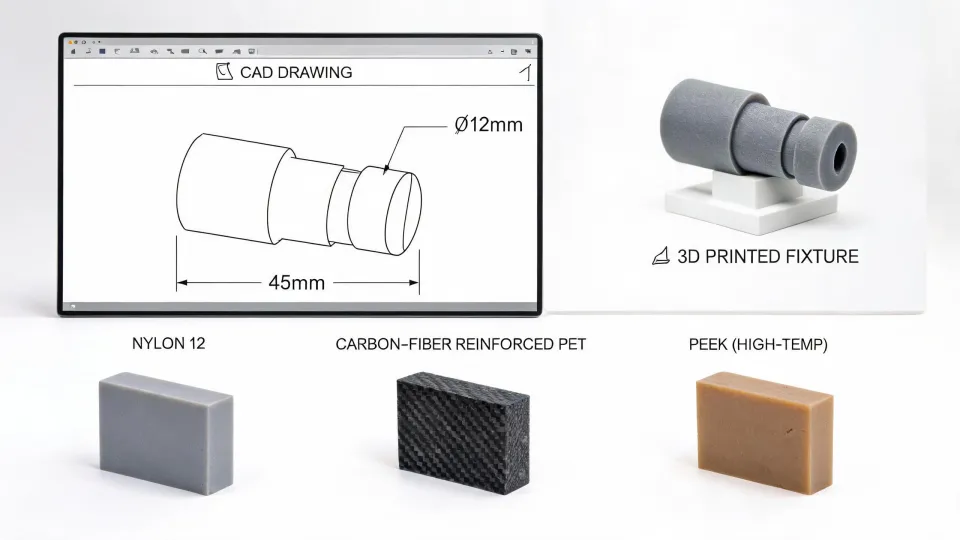
For most professional desktop FDM printers, a realistic menu includes PLA, PETG, and TPU. ABS needs a machine with an enclosure and good ventilation, so it belongs on a different shortlist. Nylon and polycarbonate require higher hotend temperatures. Composite materials, like carbon-fiber-filled Nylon, need hardened steel or specialty print cores.
So before you ask 'can it print this material?' ask what the part will experience. A prototype that sits on a desk is fine in PLA. A hinge or gasket wants TPU or PETG. A bracket exposed to heat or stress may need a higher-grade material, and that might push you toward a different printer class entirely.
How to Know Which Scenario You're In
If you're still not sure, answer four questions before requesting a quote.
- How many hours per week will the printer actually run? Under five hours: scenario one. More than twenty: scenario two.
- Who will maintain it? No dedicated technician? Pick a machine with manufacturer support and prebuilt profiles.
- What does a failed print cost? If it wastes only filament, buy cheaper. If it wastes an engineer's day or a customer deadline, invest more.
- Is this a one-off purchase or the start of a production workflow? If there's any chance you'll scale, choose an ecosystem you can grow into.
If you're still torn, start with an Ultimaker S3 and Cura. Not because it's the cheapest option, but because it's the same software ecosystem used by larger Ultimaker printers and Digital Factory. You can expand later without throwing away everything your team has learned.
The Purchase Is about Workflow, Not Hardware
For a buyer, the clearest sign that a printer was the right choice is when people stop talking about print failures. That only happens when the software profile, material, and machine line up.
The one time I ignored my instincts and approved a lower-priced printer, it cost the engineering team more hours than the price difference was worth. The numbers said one thing; my gut said another. These days I trust the workflow logic more than the spec sheet.
If you ask me, the smarter question isn't 'which printer has better specs?' It's 'which Ultimaker will make my team more efficient?' For many teams, that answer starts with Cura software and a machine the whole team can actually operate.