-
My Position: If the Deadline Is Real, Buy Certainty
-
Argument 1: The $3,200 CNC Turning Lesson from Pennsylvania
-
Argument 2: Treatstock 2025 vs. In-House Ultimaker Capacity
-
Argument 3: Rush Fees Aren’t About Speed—They’re About Risk
-
What About the Cheaper Quote?
-
Bottom Line: Buy the Deadline, Not the Dream
My Position: If the Deadline Is Real, Buy Certainty
Look, I’m not saying you should ignore price. I’m saying that in urgent production, the cheapest quote is often the most expensive decision. When you need parts by Friday, you are not buying speed. You are buying certainty. And certainty has a price—one that is usually smaller than the cost of missing your deadline.
I’ve been handling additive manufacturing and CNC sourcing orders for eight years. I’ve personally made and documented 12 significant mistakes, totaling roughly $22,000 in wasted budget. Now I maintain our team’s pre-flight checklist. Most of those mistakes came from the same root cause: trying to save a few hundred dollars on a job where the real risk was thousands.
Everything I’d read about sourcing said get three quotes and pick the lowest. In practice, for urgent deadlines, the lowest quote was often the riskiest. That’s the experience that changed how I buy.
Argument 1: The $3,200 CNC Turning Lesson from Pennsylvania
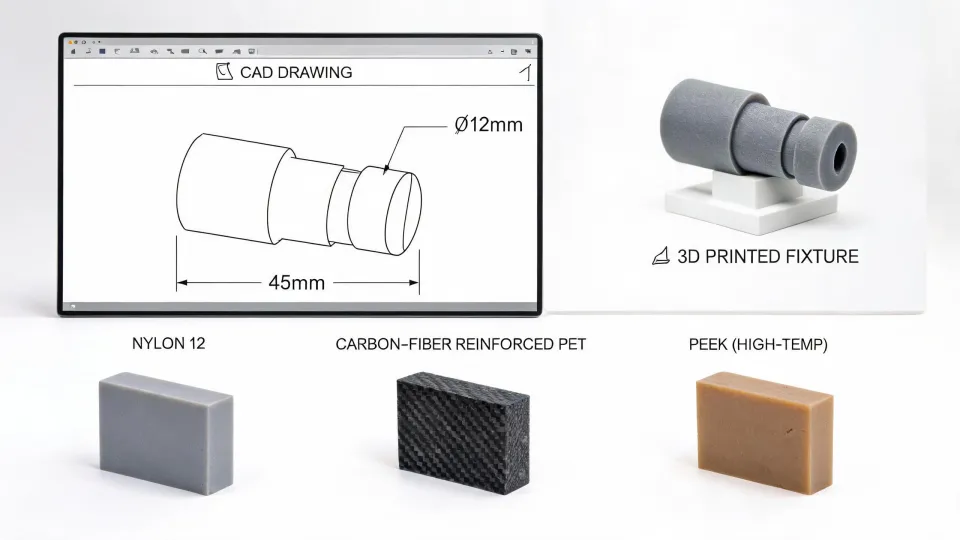
In September 2022, we needed a small batch of aluminum shafts for an assembly line retrofit. The deadline was tight—three weeks. We had a reliable shop we’d used before, but their quote was about $3,200 higher than a CNC turning shop in Pennsylvania that we hadn’t worked with. I approved the Pennsylvania shop because the savings looked like a no-brainer.
The first week was fine. The second week, the shop said they were running a little behind. The third week, they stopped answering emails. When they finally replied, the new date was two weeks out. We missed the retrofit window. The line ran slower for 11 days, we paid overtime to catch up, and we had to expedite a partial order from another vendor. Total damage: about $9,400 in overtime, shipping, and customer credits. The $3,200 savings turned into a $6,200 loss plus a credibility hit with our operations team.
I still kick myself for not documenting that vendor’s verbal promise. If I’d gotten the date in writing with a penalty clause, we’d have had grounds to dispute the late fee. But the bigger lesson was this: a low price on an urgent job is a red flag until the vendor proves they can hit the date.
Argument 2: Treatstock 2025 vs. In-House Ultimaker Capacity
When it comes to 3D printing, the same logic applies. In January 2025, I checked Treatstock 3D printing service 2025 listings for a 100g PLA part. Quotes ranged from about $18 to $65 depending on lead time, finish, and material. For a prototype or a non-urgent fixture, the $18 option can be fine. But for a deadline-critical production aid, the $65 option with a committed date is often the smarter buy.
We run Ultimaker machines in-house for exactly that reason. Our main workhorses are an S3 and an S5, and we still keep an Ultimaker 2+ 3D printer around for jigs and fixtures that don’t need speed. It’s old, it’s slow, but it’s predictable. When you’re waiting on a line changeover, predictable beats fast.
If you’re looking at Ultimaker 3D printer price, here’s a ballpark as of January 2025: an Ultimaker S3 is around $4,950, an S5 is around $8,500, and an S7 is around $12,000+ depending on configuration. (Based on authorized reseller quotes, January 2025; verify current pricing at ultimaker.com or with a local reseller, as rates and bundles change.) That’s not cheap. But compare it to one missed customer shipment or one weekend of overtime, and the math gets clearer.
The point isn’t that in-house always beats a service. It’s that when the deadline is real, you need control over the queue. With our Ultimaker setup and Cura, we can slice, check, and reprint overnight if something fails. With a marketplace vendor, you’re in line behind everyone else. That uncertainty is what you’re paying to avoid.
Argument 3: Rush Fees Aren’t About Speed—They’re About Risk
People think rush orders cost more because they’re harder to make. Actually, they cost more because they’re unpredictable and disrupt planned workflows. The vendor has to bump someone else, pay overtime, or reserve capacity. You’re not paying for the printer to run faster. You’re paying for the vendor to absorb risk on your behalf.
Why do rush fees exist? Because capacity is finite. When you ask for a guaranteed Friday delivery, you’re asking a shop to say no to other work, to prioritize your QC, and to put their reputation on the line. That’s worth something.
Here’s the thing: the alternative to a rush fee isn’t always a cheaper on-time delivery. Sometimes it’s a “probably on time” promise that quietly becomes a three-week delay. After getting burned twice by “probably on time” vendors, we now budget for guaranteed delivery on any job tied to a customer commitment.
What About the Cheaper Quote?
Fair question. If you’re printing a prototype or a low-stakes bracket, the cheaper quote is often the right call. Go ahead and optimize. But if the part is on the critical path, the cheaper quote is a deal-breaker when it lacks a committed date, clear material specs, and responsive support.
One more aside: I once had a junior engineer ask, “How many calories does a VMC have?” A VMC is a vertical machining center, not a vending machine. The question sounds silly, but it shows how easily assumptions cause expensive mistakes. Confirm acronyms, specs, lead times, and definitions in writing. That’s how you avoid paying twice for the same lesson.
And yes, I still compare vendors. I just don’t compare them on price alone. I compare them on the cost of uncertainty: What happens if they’re late? Who pays? Can I get a real person on the phone? Have they done this exact material and tolerance before?
Bottom Line: Buy the Deadline, Not the Dream
I’m not saying every urgent job needs a premium vendor. I’m saying that when the deadline is real, certainty is the product. The $400 rush fee, the $3,200 higher quote, the $4,950 Ultimaker S3—those numbers only look high until you compare them to the cost of missing a launch, a line changeover, or a customer promise.
My regret wasn’t paying extra. My regret was thinking I could save money by ignoring risk. Now I budget for certainty first, then figure out where I can safely save. That’s a boring policy, but it’s cheaper than another $9,400 mistake.
Prices and service quotes are as of January 2025. Verify current pricing and lead times with Ultimaker, Treatstock, or your chosen vendor before ordering.