-
Who's writing this
-
Why FDM wins the rush, almost every time
-
Resin vs FDM: the tradeoff nobody explains properly
-
The small-order question
-
When CNC is the only honest answer
-
Laser tube cutting: the process people forget until week three
-
What the money actually looks like
-
Where this advice stops working
When a part is due tomorrow morning, my order of operations is FDM first, resin second, CNC third, laser tube cutting last — and roughly 9 out of 10 of our rush jobs never leave the FDM machine. Not because FDM is the best process in the abstract. Because it's the only one where the material, the setup, and the operator are all in the same room at the same time.
That's the answer. Everything below is why, and where it stops being true.
Who's writing this
I coordinate rush orders for an industrial fabrication shop. I've handled 400+ expedited jobs in 11 years, including same-day turnarounds for Tier-1 aerospace and medical device clients. Most of what I know, I learned by getting it wrong first.
In March 2024, a client called at 4:40 p.m. on a Thursday needing six mounting brackets for a factory acceptance test scheduled 36 hours later. Normal turnaround on that part was five business days. We sliced them on an in-house FDM machine, ran them overnight, and delivered at 7 a.m. Saturday. Missing that window would have meant pushing a $60,000 test block into the following month. The brackets cost the client under $300 in material and machine time.
Why FDM wins the rush, almost every time
Three reasons, and none of them are about print quality.
First, the software is free and it's probably already on your laptop. Ultimaker Cura downloads from ultimaker.com at no cost, and it opens STL, STEP, and 3MF files without drama. When a client emails a STEP file at 5 p.m., I'm slicing by 5:15.
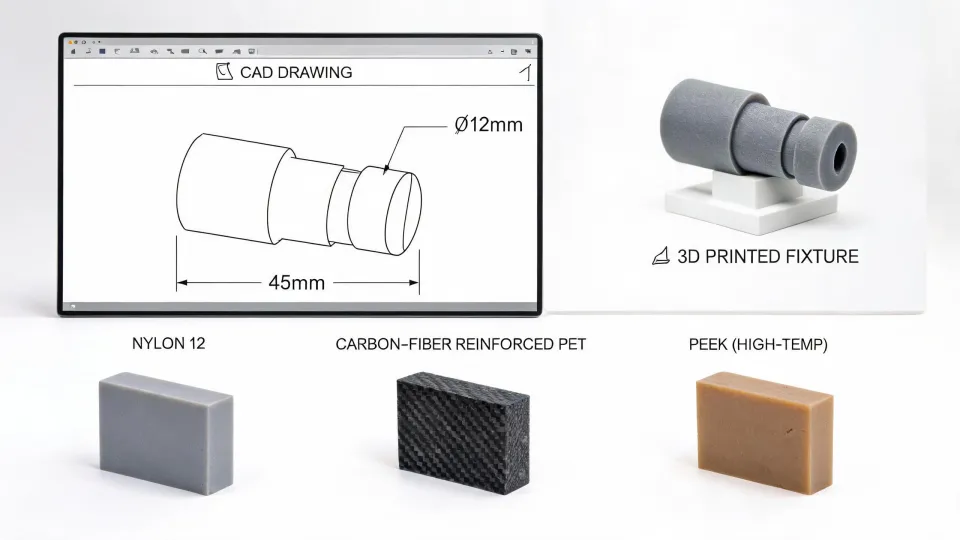
Second, materials are on the shelf. PLA, PETG, Tough PLA, and TPU cover the vast majority of functional prototypes. No resin washing, no UV curing station, no post-processing queue sitting between you and the part.
Third — and this is the one people underestimate — failure is cheap and recoverable. A failed FDM print costs a few dollars of filament and 90 minutes. A failed resin print means draining, filtering, and cleaning a vat before you can try again.
The frustrating part is that the failure mode is almost always the same one. You level the bed, you run a test patch, everything looks flat. Then the corners curl. Every time. What finally fixed it for us was an enclosure — not a better machine, just stable air temperature around the part.
Resin vs FDM: the tradeoff nobody explains properly
People searching "resin 3d printer vs 3d printer" are usually trying to decide what to buy. For a rush job, that's the wrong question. The right question is: does this part need detail it can't live without, or does it need to exist in three hours?
Resin prints detail that FDM simply can't. 0.025 mm layers, crisp threads, surfaces that look injection-molded. What that spec sheet doesn't tell you is that resin also means isopropyl washing, secondary curing, and support removal that can scratch a finished surface if you're moving fast. A validated resin job in our shop runs 4 to 6 hours from file to part. FDM runs 45 to 90 minutes.
Where resin earns its place in a rush: thread test coupons, small detail-critical features, and any part going in front of a client for a visual review. If the part has to be on a bench in four hours, FDM is the only honest option.
The small-order question
One thing I'll say plainly, because it comes up constantly: minimum order quantities on small jobs are usually a mistake.
We take $80 rush orders. We bill them the same day. The purchasing engineer who sends us a $60 bracket request this quarter is the same person signing a $25,000 blanket PO in eighteen months. Three of our largest accounts started with a single part under a hundred dollars. Small doesn't mean unimportant — it means early.
When CNC is the only honest answer
Neither FDM nor resin will hold ±0.05 mm. If the drawing calls out tight-tolerance bores, real threads, metal, or anything that has to survive 200°C, you're cutting material, not depositing it.
The Tormach PCNC 440 comes up a lot in this conversation because it sits in a specific sweet spot — small enough for a garage or a back-room cell, capable enough to actually cut aluminum. As of January 2025, the bare mill lists in the mid four figures at tormach.com, but a working setup with tool holders, a vise, a touch probe, and coolant realistically lands somewhere between $9,000 and $13,000. Verify current pricing directly with Tormach before you plan around a number — that hardware has repriced more than once in the last three years.
For a rush job, though, don't buy the machine. Call a shop that already has one. A small CNC job shop with an open slot can take a simple aluminum part from program to finished in two to three hours, and they'll quote it off the STEP file in under an hour.
Laser tube cutting: the process people forget until week three
Laser tube cutting does something no printer or mill does well: holes, slots, and compound end cuts in square, round, and rectangular tube, in one pass, with essentially no secondary cleanup.
Laser tube cutting shops in the Cottage Grove area will usually quote within a few hours of receiving a DXF or STEP file. Midwest tube cutting rates were running roughly $80–$150 per hour of cut time in early 2025, plus material, with rush premiums on top. There's an obvious limit: the geometry has to be cuttable. Frames, brackets, and chassis rails off tube? Perfect fit. Curved organic surfaces out of tube? Redesign first.
What the money actually looks like
Ultimaker doesn't publish list prices on its site. Reseller quotes for the S3 landed around $4,000–$5,500 in late 2024, with the S5 in the $6,500–$8,000 range. Check with a current reseller before budgeting — those numbers were still moving as of January 2025.
On the used market: if you found this page searching for "Ultimaker 3 3d printer price," that machine launched in 2016 and was discontinued years ago. Used units show up in the $400–$900 range, and my honest advice is not to buy one for a rush job. Discontinued hardware means discontinued parts, and the day a thermocouple fails is the day your deadline moves. Send the file to someone with an active machine instead.
The comparison that actually matters isn't printer price against printer price. It's machine cost against the cost of missing the date. We've had two clients justify an entire printer purchase off a single avoided schedule slip.
Where this advice stops working
It stops working in a few specific places, and you should know them before you commit.
- Part size. Above roughly 250 mm in any dimension, desktop FDM is out and you're into industrial machines or a different process entirely.
- Certified materials. Aerospace and implantable medical work usually requires validated material batches and process documentation. A desktop machine won't get you there, regardless of what the print looks like.
- Under six hours. If the deadline is inside six hours, stop trying to make something. Check for an off-the-shelf equivalent, modify a stock part, or turn it on a lathe. Every sub-four-hour print job we've attempted ran twice and still finished behind a modified standard part.
One last thing, and it's the cheapest lesson here: nearly every rush order I've watched fail traced back to someone accepting a deadline before opening the file. Open it first. Check the wall thickness. Measure the hole diameter. Those two minutes are the highest-return two minutes in the entire job.