Bottom line: If you need a functional prototype or a short production run in under 48 hours, Ultimaker Digital Factory is the most reliable safety net I've seen in eight years of managing rush orders. It won't fix bad geometry, and it won't make a metal part. But it will cut the orchestration time that usually eats your deadline.
I'm a production coordinator at a product development firm outside Detroit. I've handled more than 200 rush orders in that time — same-day turnarounds for clients with expo booths, emergency replacement fixtures for an assembly line that stopped, and one $15,000 tooling job that needed a bridge part within 72 hours.
Lead times are padded. Act accordingly.
Here's something vendors won't tell you: “standard turnaround” usually includes buffer time. When a CNC shop says five days, they're not saying your part literally needs five days of cutting. It might be two days in their queue, six hours of actual machining, and two days of wiggle room. The wiggle room is for their other customers, not you.
People think rush orders cost more because they're harder. Actually, they cost more because they're unpredictable and disrupt planned workflows. The part itself isn't harder at 9 pm — but asking a shop to stop what it's doing and set up your job is what you're paying for.
That's where Ultimaker Digital Factory changes the math. Instead of waiting in a queue, I can distribute a print job across connected machines and start overnight. Last quarter alone, we processed 47 rush jobs with 95% on-time delivery. Digital Factory was the main reason.
The March 2023 wake-up call
The vendor failure in March 2023 changed how I think about backup planning. A client's event placement depended on a set of twenty mounting brackets. Our normal CNC partner promised a 72-hour turnaround, then one of their machines went down. They didn't tell us until hour 60. We had less than 36 hours left.
We found another shop with a mill that could handle it, paid $1,400 in rush fees, and delivered with 11 hours to spare. The client's alternative was losing $12,000 worth of custom signage. That's when I implemented a “no single-vendor urgency” policy. Now every rush job starts with a quick process decision, and Digital Factory is checked first.
How long does cnc machining take? Depends.
So, how long does cnc machining take? The honest answer is three to fifteen days. Simple aluminum parts from a well-scheduled shop run 3–5 business days. Complex 5-axis work needs 1–2 weeks. A rush quote can sometimes get you 48 hours, at 2–3 times standard price — and even that depends on material stock and whether the shop has a free spindle.
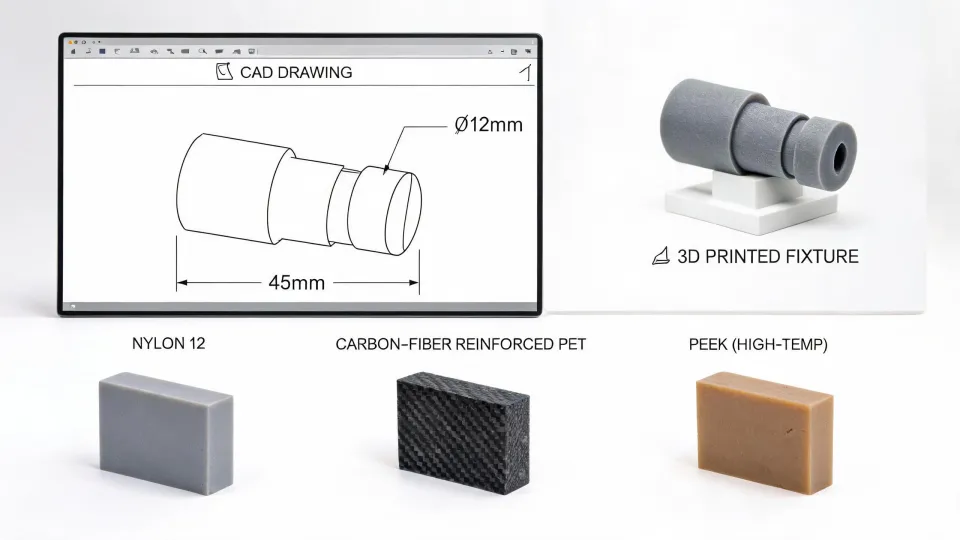
Compare that to our Ultimaker network. A typical bracket or fixture in PA12 is an overnight job. We've printed 40 identical parts between 10 pm and 6 am across two Ultimaker S5 units. No waiting in someone else's queue.
Laser searches, process choices, and recovery time
I'll admit, some Google searches are strange. If your part is being cut with a fiber laser source 1000w, don't call me about an FDM printer. That kind of laser cuts and welds sheet steel; it's a different universe from a 0.4 mm nozzle. Know your material requirement before you pick the process.
Even the odd query co2 laser under eyes recovery time photos has a lesson. People search it because they're worried about downtime. Same in manufacturing. The “recovery time” for a process is the setup, calibration, and post-processing nobody puts in the quote. A 1000W fiber laser source might seem fast, but if you need a specific edge finish, you still have secondary operations.
For example, a medical device company called us in April 2024 with a fixture that normally went to their CNC vendor. They needed twelve clips in a flame-retardant plastic. CNC quote: $800 and eight days. We printed them on an Ultimaker S5 with a validated polycarbonate profile and had them on a truck in 36 hours. The parts weren't as pretty, but they passed functional testing. That's the trade-off.
Ultimaker 2 3d printer specs: what actually matters
I see a lot of people obsess over Ultimaker 2 3d printer specs because they found one used and want to know if it's still useful. It is. The 230 x 225 x 205 mm build volume, the 0.4 mm nozzle, the 2.85 mm filament path — those are enough for plenty of engineering parts. But the real advantage now isn't the printer alone; it's the software and platform around it.
Ultimaker Digital Factory changes the decision. With remote job queueing, print profiles, and fleet monitoring, I can manage six machines from my desk instead of running between them with SD cards. That's what made our overnight bracket sprint possible.
Where the magic ends
Digital Factory is not a replacement for a fiber laser source 1000w, a CNC mill, or any machine that removes metal. It also won't give you a surgical-grade cosmetic result. If you're the person looking at co2 laser under eyes recovery time photos, that is a medical question, not a manufacturing one.
I do not use Digital Factory for anything that needs full density metal or a specific isotropic strength. I do not use it for large flat items that would take 20 hours to print when a fiber laser source 1000w cuts them in four minutes. I do not use it when the customer says “we'll wait, just make it perfect.” If time is not the constraint, choose the process that gives the best surface and material properties, not the quickest one.
Per FTC guidelines (ftc.gov), performance claims have to be truthful and not misleading, so let me be straight: I have never had a 100% on-time record. Last quarter, 47 rush orders, 45 on time. The two late ones were due to material shortages that no printer could solve. If a salesperson promises you a guaranteed overnight turnaround, ask them how many orders landed late last month. If they cannot answer, it's marketing.
The last bottleneck is shipping
Once the part is finished, you still have to get it somewhere. According to USPS (usps.com), a First-Class Mail letter costs $0.73 as of January 2025. That only helps if your part fits in a 1-oz envelope. Real parts go in padded mailers and cost more. Plan for that.
The part isn't late until the shipping label is on the box.
So here's my actual advice. When you're in a deadline crunch, stop asking “which printer should I buy?” and start asking “what does the part need to do by Thursday?” If the answer is a functional bracket, a fixture, or a short run in a common plastic, Ultimaker Digital Factory is probably your fastest route. If it's metal, if it needs a fiber laser source 1000w, or if your search history actually started with co2 laser under eyes recovery time photos, this is not the machine.